JEE Main 2026 · 2 Apr · Shift 2 · Geometric Progression
Let be an A.P. and be an increasing G.P. If and , then is equal to:
- (A)
81
- (B)
76
- (C)
62
- (D)
55
Show answerHide answer
Answer: (D)
Sequences & Series has 247 questions in JEE Main papers from 2020 to 2026, about 35 per year across all shifts. The free PDF has 246 of them, each with its answer. The most asked topic is Arithmetic Progression (89 questions), followed by Geometric Progression (53) and Special Sums (48).
Answer key includedNo loginPractise online
Source: official NTA JEE Main papers · Updated
Your PDF is downloading. Practise these questions online, free, no login →
12 of this chapter's questions came back in a later paper (2021–2026). See the most repeated.
Sequences & Series had about 1.7 questions per shift in recent JEE Main papers (2024–26). It's one of the most asked Mathematics chapters. Most asked topic: Arithmetic Progression. About 33 questions in the 2026 papers. (Some topics were cut in 2024; see what changed.)
It came up in almost every 2024–26 shift in our bank (about 56 shifts). Question types in 2020–2026: about 163 MCQs and about 84 numerical.
| Year | Questions | Per shift | MCQ | Numerical |
|---|---|---|---|---|
| 2026 | 33 | 1.7 | 27 | 6 |
| 2025 | 29 | 1.5 | 26 | 3 |
| 2024 | 38 | 1.9 | 25 | 13 |
| 2023 | 41 | 1.7 | 19 | 22 |
| 2022 | 39 | 1.7 | 20 | 19 |
| 2021 | 39 | 1.5 | 23 | 16 |
| 2020 | 28 | 1.8 | 23 | 5 |
| 2020–2026 | 247 | 1.7 | 163 | 84 |
| Topic | Questions |
|---|---|
| Arithmetic Progression | 89 |
| Geometric Progression | 53 |
| Special Sums | 48 |
| Telescoping Series | 41 |
| Arithmetico-Geometric Progression | 15 |
Every topic, year by year, is in the topic-wise table further down.
Counted from PrepWiser's question bank of JEE Main papers, 2020–2026. Per shift = questions that year ÷ shifts in our bank. Updated .
Two free sheets, made from the past JEE Main questions on this chapter.
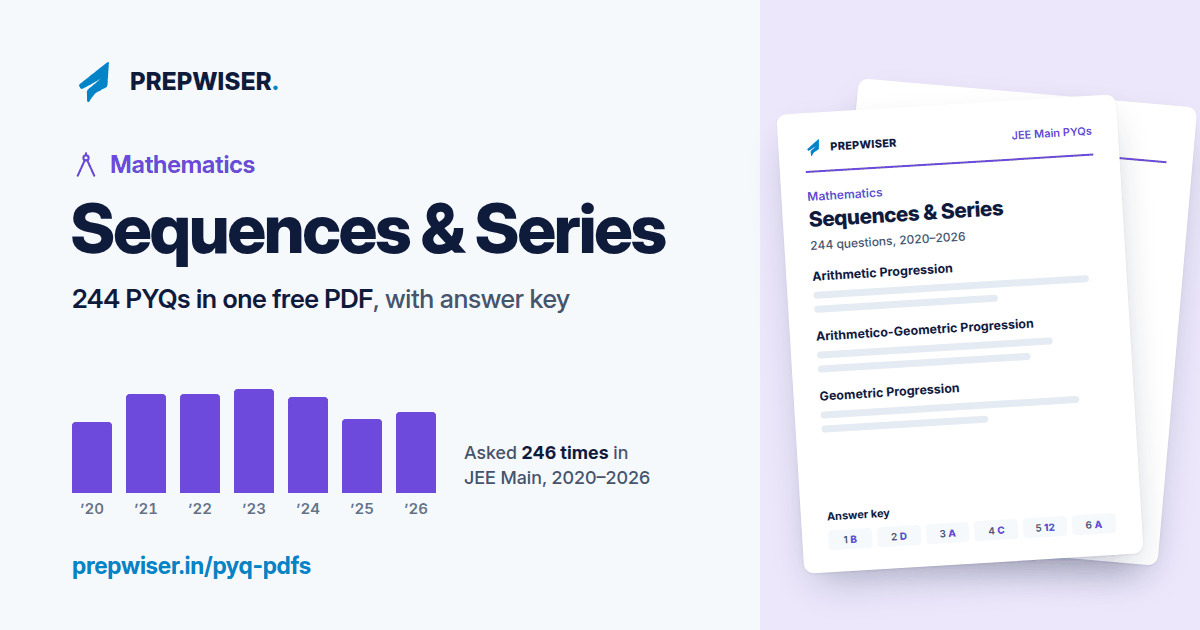
The link opens this page: the free PDF with 246 questions and answers, and online practice. Nobody needs to log in.
| Year | Asked | In PDF | |
|---|---|---|---|
| 2026 | 33 | 33 | |
| 2025 | 29 | 29 | |
| 2024 | 38 | 37 | |
| 2023 | 41 | 41 | |
| 2022 | 39 | 39 | |
| 2021 | 39 | 39 | |
| 2020 | 28 | 28 |
in the free PDF asked, not in the PDFThe PDF only has questions we can print in full with a checked answer, so it holds 246 of the 247 asked.
How many Sequences & Series questions each topic had in every JEE Main year (all shifts), counting every question asked, including ones not in the PDF. Darker cells mean more questions.
| Topic | Asked | Share | 2026 | 2025 | 2024 | 2023 | 2022 | 2021 | 2020 |
|---|---|---|---|---|---|---|---|---|---|
| Arithmetic Progression | 89 | 36% | 14 | 12 | 16 | 11 | 11 | 12 | 13 |
| Geometric Progression | 53 | 22% | 6 | 5 | 8 | 10 | 9 | 9 | 6 |
| Special Sums | 48 | 19% | · | 5 | 8 | 12 | 5 | 10 | 8 |
| Telescoping Series | 41 | 17% | 12 | 6 | 4 | 4 | 9 | 6 | · |
| Arithmetico-Geometric Progression | 15 | 6% | 1 | 1 | 2 | 3 | 5 | 2 | 1 |
| Harmonic Progression | 1 | 0% | · | · | · | 1 | · | · | · |
| All topics | 247 | 100% | 33 | 29 | 38 | 41 | 39 | 39 | 28 |
Swipe the table sideways for older years.
The 12 newest of the 33 JEE Main 2026 Sequences & Series questions in the free PDF, latest shift first.
JEE Main 2026 · 8 Apr · Shift 2 · Arithmetic Progression
Let upto 40 terms. If is a root of the equation , then is equal to :
JEE Main 2026 · 6 Apr · Shift 1 · Telescoping Series
The value of is:
JEE Main 2026 · 6 Apr · Shift 1 · Arithmetic Progression
The sum of the first ten terms of an A.P. is 160 and the sum of the first two terms of a G.P. is 8 . If the first term of the A.P. is equal to the common ratio of the G.P. and the first term of the G.P. is equal to common difference of the A.P., then the sum of all possible values of the first term of the G.P. is:
JEE Main 2026 · 6 Apr · Shift 1 · Arithmetic Progression
For the functions , and , let . If the first term of a G.P. is , its common ratio is and the sum of its first 10 terms is , then is equal to .
JEE Main 2026 · 6 Apr · Shift 2 · Telescoping Series
The sum upto 10 terms is equal to :
JEE Main 2026 · 6 Apr · Shift 2 · Arithmetic Progression
Consider the quadratic equation . Let be the minimum value of the product of its roots and be the maximum value of the sum of its roots. Then the sum of the first six terms of the G.P., whose first term is and the common ratio is , is :
JEE Main 2026 · 5 Apr · Shift 1 · Arithmetic Progression
Let the sum of the first terms of an A.P. be . Then the sum of squares of the first 10 terms of the A.P. is:
JEE Main 2026 · 5 Apr · Shift 2 · Arithmetic Progression
Let be 39 arithmetic means between the numbers 59 and 159. Then the mean of and is equal to :
JEE Main 2026 · 5 Apr · Shift 1 · Telescoping Series
is equal to:
JEE Main 2026 · 5 Apr · Shift 2 · Telescoping Series
If the sum of the first 10 terms of the series . is , then is equal to :
JEE Main 2026 · 4 Apr · Shift 1 · Arithmetic Progression
The first term of an A.P. of 30 non-negative terms is . If the sum of this A.P. is the cube of its last term, then its common difference is:
JEE Main 2026 · 4 Apr · Shift 2 · Geometric Progression
Let and . Then the value of is equal to:
JEE Main 2026 · 2 Apr · Shift 2 · Geometric Progression
Let be an A.P. and be an increasing G.P. If and , then is equal to:
81
76
62
55
Answer: (D)
JEE Main 2026 · 28 Jan · Shift 2 · Arithmetico-Geometric Progression
is equal to :
Answer: (A)
JEE Main 2025 · 8 Apr · Shift 2 · Special Sums
If ,
,
,
then is equal to :
23
14
18
15
Answer: (D)
JEE Main 2023 · 8 Apr · Shift 2 · Harmonic Progression
Let be three real numbers such that are in an arithmetic progression and are in a geometric progression. If , then is equal to ____________.
Answer: 150
The free PDF above has all 246 questions grouped by topic, with an answer key.
Answer Sequences & Series PYQs in the browser, get each one checked instantly and open the step-by-step solution where there is one.
Practise Sequences & Series online247 questions from 2020 to 2026, about 35 per year. In 2026 it had 33. The free PDF has 246 of them.
By past papers: Arithmetic Progression (36%), Geometric Progression (22%) and Special Sums (19%) of all Sequences & Series questions.
Yes. The PDF and its answer key are free, and you can practise the questions online with no login, with step-by-step solutions where available.
Prefer to solve online? Practise Sequences & Series online with step-by-step solutions where available, or work through JEE Main papers shift by shift.
JEE Main PYQs by year: 2026 · 2025 · 2024 · 2023 · 2022 · 2021 · 2020
Answers follow NTA's final answer keys. Typing errors are possible, so check doubtful answers against the official key. Spotted a mistake? prepwiser.in/feedback · Terms: prepwiser.in/terms