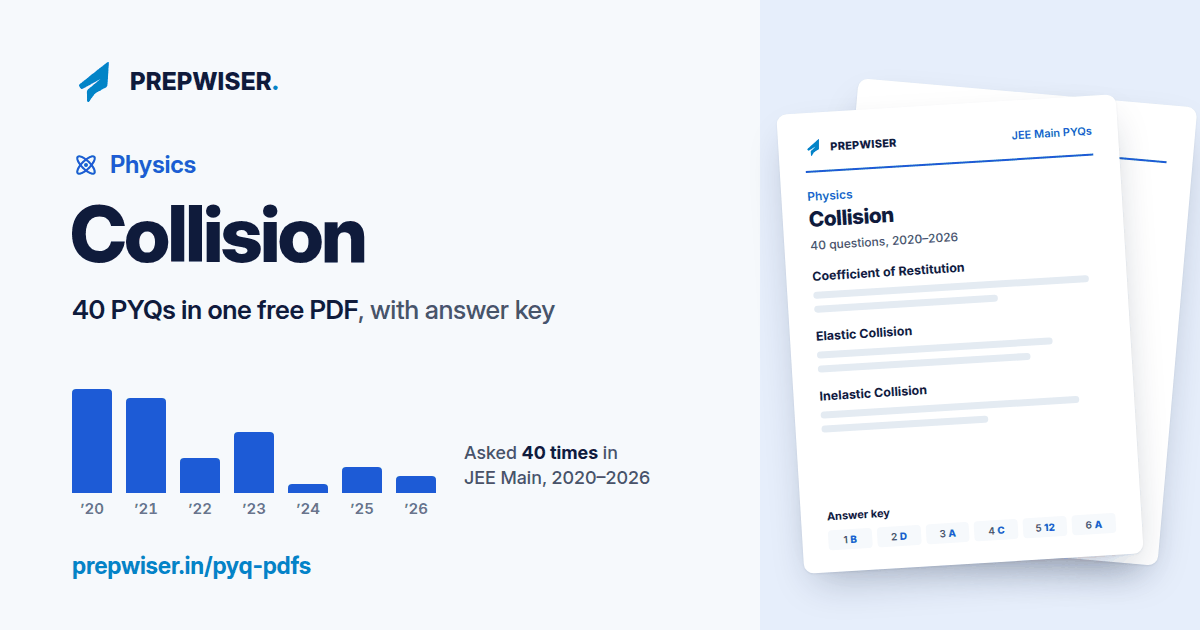
Collision has 40 questions in JEE Main papers from 2020 to 2026, about 5.7 per year across all shifts. All 40 are in the free PDF, with an answer key. The most asked topic is Inelastic Collision (18 questions), followed by Elastic Collision (15) and Oblique Collision (5).
Asked in JEE Main
402020–2026, all shifts
In this free PDF
40all of them, with answers
Asked in 2026
2Latest paper: 2026 Jan S1
Most asked topic
Inelastic Collision18 Qs · 45% of the chapter
Difficulty mix
25% easy · 73% medium · 2% hardof the questions in the PDF
Collision had about 0.1 questions per shift in recent JEE Main papers (2024–26). Its share has fallen since 2020–22. Most asked topic: Inelastic Collision. About 2 questions in the 2026 papers.
It came up in about 5 of the 2024–26 shifts in our bank. Question types in 2020–2026: about 27 MCQs and about 13 numerical.
How many questions from Collision in JEE Main, year by year
Year
Questions
Per shift
MCQ
Numerical
2026
2
0.1
2
0
2025
3
0.2
3
0
2024
1
<0.1
1
0
2023
7
0.3
4
3
2022
4
0.2
3
1
2021
11
0.4
6
5
2020
12
0.8
8
4
2020–2026
40
0.3
27
13
Most asked Collision topics, 2020–2026
Topic
Questions
Inelastic Collision
18
Elastic Collision
15
Oblique Collision
5
Coefficient of Restitution
2
Counted from PrepWiser's question bank of JEE Main papers, 2020–2026. Per shift = questions that year ÷ shifts in our bank. Updated .
How many Collision questions each topic had in every JEE Main year (all shifts), counting every question asked, including ones not in the PDF. Darker cells mean more questions.
Topic
Asked
Share
2026
2025
2024
2023
2022
2021
2020
Inelastic Collision
18
45%
1
1
1
3
2
3
7
Elastic Collision
15
38%
1
2
·
2
2
4
4
Oblique Collision
5
12%
·
·
·
·
·
4
1
Coefficient of Restitution
2
5%
·
·
·
2
·
·
·
All topics
40
100%
2
3
1
7
4
11
12
Swipe the table sideways for older years.
Newest questions (2026)
All 2 JEE Main 2026 Collision questions in the free PDF, latest shift first.
JEE Main 2026 · 23 Jan · Shift 1 · Inelastic Collision
In a perfectly inelastic collision, two spheres made of the same material with masses 15 kg and 25 kg , moving in opposite directions with speeds of 10m/s and 30m/s, respectively, strike each other and stick together. The rise in temperature (in ∘C ), if all the heat produced during the collision is retained by these spheres, is :
(specific heat of sphere material 31cal/kg.∘C and 1cal=4.2J )
JEE Main 2026 · 23 Jan · Shift 1 · Elastic Collision
A small bob A of mass m is attached to a massless rigid rod of length 1 m pivoted at point P and kept at an angle of 60∘ with vertical as shown in figure. At distance of 1 m below point P, an identical bob B is kept at rest on a smooth horizontal surface that extends to a circular track of radius R as shown in figure. If bob B just manages to complete the circular path of radius R upto a point Q after being hit elastically by bobA, then radius R is ____ m.
Consider two blocks A and B of masses m1=10kg and m2=5kg that are placed on a frictionless table. The block A moves with a constant speed v=3m/s towards the block B kept at rest. A spring with spring constant k=3000N/m is attached with the block B as shown in the figure. After the collision, suppose that the blocks A and B, along with the spring in constant compression state, move together, then the compression in the spring is, (Neglect the mass of the spring)
JEE Main 2025 · 29 Jan · Shift 2 · Elastic Collision
Given below are two statements. One is labelled as Assertion (A) and the other is labelled as Reason (R).
Assertion (A): Three identical spheres of same mass undergo one dimensional motion as shown in figure with initial velocities vA=5m/s,vB=2m/s,vC=4m/s. If we wait sufficiently long for elastic collision to happen, then vA=4m/s,vB=2m/s, vC=5m/s will be the final velocities.
Reason (R): In an elastic collision between identical masses, two objects exchange their velocities.
In the light of the above statements, choose the correct answer from the options given below:
(A)
Both (A) and (R) are true but (R) is NOT the correct explanation of (A)
(B)
Both (A) and (R) are true and (R) is the correct explanation of (A)
JEE Main 2023 · 6 Apr · Shift 2 · Coefficient of Restitution
A body is dropped on ground from a height 'h1' and after hitting the ground, it rebounds to a height 'h2'. If the ratio of velocities of the body just before and after hitting ground is 4 , then percentage loss in kinetic energy of the body is 4x. The value of x is ____________.
JEE Main 2021 · 31 Aug · Shift 1 · Oblique Collision
A body of mass M moving at speed V0 collides elastically with a mass 'm' at rest. After the collision, the two masses move at angles θ1 and θ2 with respect to the initial direction of motion of the body of mass M. The largest possible value of the ratio M/m, for which the angles θ1 and θ2 will be equal, is :
Answers follow NTA's final answer keys. Typing errors are possible, so check doubtful answers against the official key. Spotted a mistake? prepwiser.in/feedback · Terms: prepwiser.in/terms


 Three identical spheres of same mass undergo one dimensional motion as shown in figure with initial velocities