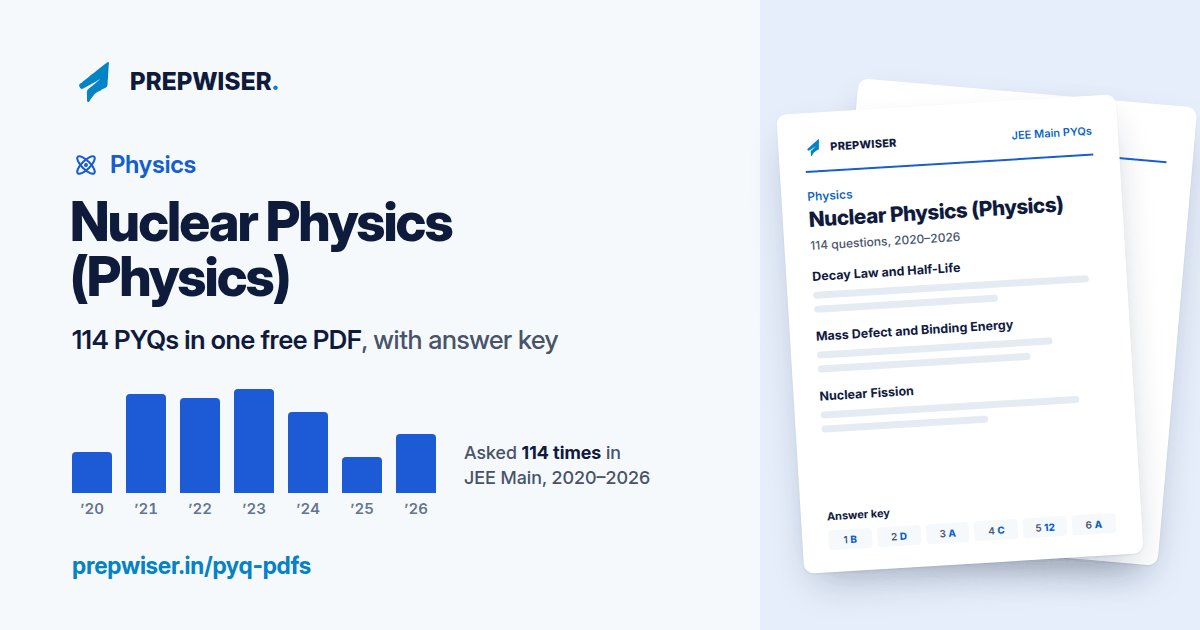
Nuclear Physics has 114 questions in JEE Main papers from 2020 to 2026, about 16 per year across all shifts. All 114 are in the free PDF, with an answer key. The most asked topic is Decay Law and Half-Life (42 questions), followed by Mass Defect and Binding Energy (30) and Nuclear Size and Density (15).
Asked in JEE Main
1142020–2026, all shifts
In this free PDF
114all of them, with answers
Asked in 2026
13Latest paper: 2026 Apr S2
Most asked topic
Decay Law and Half-Life42 Qs · 37% of the chapter
Difficulty mix
60% easy · 38% medium · 2% hardof the questions in the PDF
13 of this chapter's questions came back in a later paper (2021–2026). See the most repeated.
How often it's asked in JEE Main
Nuclear Physics had about 0.7 questions per shift in recent JEE Main papers (2024–26). Most asked topic in 2024–26: Mass Defect and Binding Energy. About 13 questions in the 2026 papers. (Some topics were cut in 2024; see what changed.)
It came up in most 2024–26 shifts in our bank (about 35 shifts). Question types in 2020–2026: about 87 MCQs and about 27 numerical.
How many questions from Nuclear Physics in JEE Main, year by year
Year
Questions
Per shift
MCQ
Numerical
2026
13
0.7
11
2
2025
8
0.4
8
0
2024
18
0.9
11
7
2023
23
1.0
14
9
2022
21
0.9
16
5
2021
22
0.8
18
4
2020
9
0.6
9
0
2020–2026
114
0.8
87
27
Most asked Nuclear Physics topics, 2020–2026
Topic
Questions
Decay Law and Half-Life
42
Mass Defect and Binding Energy
30
Nuclear Size and Density
15
Radioactivity
12
Nuclear Fission
10
Every topic, year by year, is in the topic-wise table further down.
Counted from PrepWiser's question bank of JEE Main papers, 2020–2026. Per shift = questions that year ÷ shifts in our bank. Updated .
How many Nuclear Physics questions each topic had in every JEE Main year (all shifts), counting every question asked, including ones not in the PDF. Darker cells mean more questions.
Topic
Asked
Share
2026
2025
2024
2023
2022
2021
2020
Decay Law and Half-Life
42
37%
·
2
·
8
12
16
4
Mass Defect and Binding Energy
30
26%
7
2
9
7
1
1
3
Nuclear Size and Density
15
13%
3
2
3
3
3
·
1
Radioactivity
12
11%
1
1
·
3
2
5
·
Nuclear Fission
10
9%
1
1
3
2
2
·
1
Nuclear Fusion
5
4%
1
·
3
·
1
·
·
All topics
114
100%
13
8
18
23
21
22
9
Swipe the table sideways for older years.
Newest questions (2026)
The 12 newest of the 13 JEE Main 2026 Nuclear Physics questions in the free PDF, latest shift first.
JEE Main 2026 · 8 Apr · Shift 2 · Radioactivity
Two radioactive substances A and B of mass numbers 200 and 212 respectively, shows spontaneous α-decay with same Q value of 1 MeV . The ratio of energies of α-rays produced by A and B is ____ .
JEE Main 2026 · 6 Apr · Shift 1 · Mass Defect and Binding Energy
The energy released when 17.137kg of 37Li is converted into 24He by proton bombardment is α×1032eV. The value of α is ____ . (Nearest integer) (Mass of 37Li=7.0183u, mass of 24He=4.004u, mass of proton =1.008u and 1u=931MeV/c2 and Avogadro number =6.0×10²³ )
JEE Main 2026 · 4 Apr · Shift 1 · Mass Defect and Binding Energy
Two nuclei of mass number 3 combine with another nucleus of mass number 4 to yield a nucleus of mass number 10. If the binding energy per nucleon for the mass numbers 3,4 and 10 are 5.6MeV,7.4MeV and 6.1 MeV , respectively, then in the process, ΔMc2=____ MeV .
JEE Main 2026 · 28 Jan · Shift 1 · Nuclear Size and Density
An atom 38X is bombarded by shower of fundamental particles and in 10 s this atom absorbed 10 electrons, 10 protons and 9 neutrons. The percentage growth in the surface area of the nucleons is recorded by :
JEE Main 2026 · 23 Jan · Shift 2 · Nuclear Fission
The average energy released per fission for the nucleus of 92235U is 190 MeV . When all the atoms of 47 g pure 92235U undergo fission process, the energy released is α×1023MeV. The value of α is ____ .
JEE Main 2025 · 4 Apr · Shift 2 · Decay Law and Half-Life
A radioactive material P first decays into Q and then Q decays to non-radioactive material R. Which of the following figure represents time dependent mass of P,Q and R ?
A star has 100% helium composition. It starts to convert three 4He into one 12C via triple alpha process as 4He+4He+4He→12C+Q. The mass of the star is 2.0×1032kg and it generates energy at the rate of 5.808×1030W. The rate of converting these 4He to 12C is n×1042s−1, where n is _________. [ Take, mass of 4He=4.0026u, mass of 12C=12u]
How many questions come from Nuclear Physics in JEE Main?
114 questions from 2020 to 2026, about 16 per year. In 2026 it had 13.
Which Nuclear Physics topics are most important for JEE Main?
By past papers: Decay Law and Half-Life (37%), Mass Defect and Binding Energy (26%) and Nuclear Size and Density (13%) of all Nuclear Physics questions.
Is the Nuclear Physics PYQ PDF free?
Yes. The PDF and its answer key are free, and you can practise the questions online with no login, with step-by-step solutions where available.
Answers follow NTA's final answer keys. Typing errors are possible, so check doubtful answers against the official key. Spotted a mistake? prepwiser.in/feedback · Terms: prepwiser.in/terms