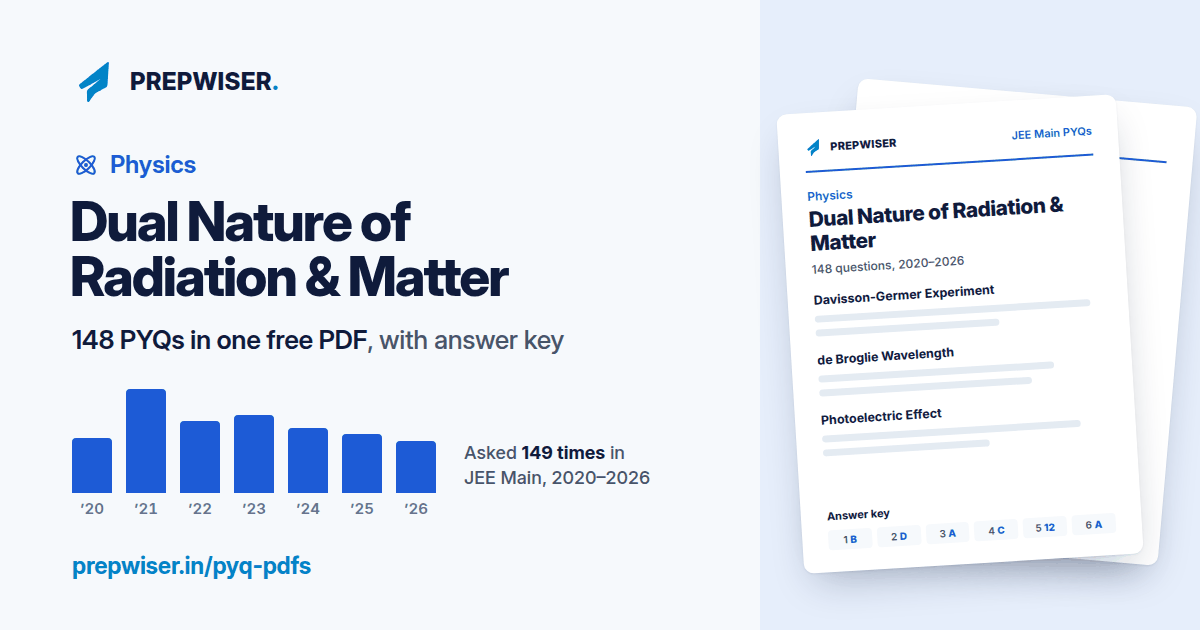
Dual Nature of Radiation & Matter JEE Main PYQs PDF, 2020–2026
Dual Nature of Radiation & Matter has 149 questions in JEE Main papers from 2020 to 2026, about 21 per year across all shifts. The free PDF has 148 of them, each with its answer. The most asked topic is Photoelectric Effect (73 questions), followed by de Broglie Wavelength (59) and Davisson-Germer Experiment (10).
Asked in JEE Main
1492020–2026, all shifts
In this free PDF
148with answers
Asked in 2026
16Latest paper: 2026 Apr S2
Most asked topic
Photoelectric Effect73 Qs · 49% of the chapter
Difficulty mix
56% easy · 43% medium · 1% hardof the questions in the PDF
16 of this chapter's questions came back in a later paper (2021–2026). See the most repeated.
How often it's asked in JEE Main
Dual Nature of Radiation & Matter had about 0.9 questions per shift in recent JEE Main papers (2024–26). Most asked topic: Photoelectric Effect. About 16 questions in the 2026 papers. (Some topics were cut in 2024; see what changed.)
It came up in most 2024–26 shifts in our bank (about 48 shifts). Question types in 2020–2026: about 133 MCQs and about 16 numerical.
How many questions from Dual Nature of Radiation & Matter in JEE Main, year by year
Year
Questions
Per shift
MCQ
Numerical
2026
16
0.8
13
3
2025
18
0.9
16
2
2024
20
1.0
20
0
2023
24
1.0
24
0
2022
22
1.0
20
2
2021
32
1.2
27
5
2020
17
1.1
13
4
2020–2026
149
1.0
133
16
Most asked Dual Nature of Radiation & Matter topics, 2020–2026
Topic
Questions
Photoelectric Effect
73
de Broglie Wavelength
59
Davisson-Germer Experiment
10
Work Function and Threshold Frequency
7
Counted from PrepWiser's question bank of JEE Main papers, 2020–2026. Per shift = questions that year ÷ shifts in our bank. Updated .
Dual Nature of Radiation & Matter questions per year
Year
Asked
In PDF
2026
16
16
2025
18
18
2024
20
20
2023
24
24
2022
22
22
2021
32
32
2020
17
16
in the free PDF asked, not in the PDFThe PDF only has questions we can print in full with a checked answer, so it holds 148 of the 149 asked.
Topic-wise weightage by year
How many Dual Nature of Radiation & Matter questions each topic had in every JEE Main year (all shifts), counting every question asked, including ones not in the PDF. Darker cells mean more questions.
Topic
Asked
Share
2026
2025
2024
2023
2022
2021
2020
Photoelectric Effect
73
49%
9
10
13
9
12
12
8
de Broglie Wavelength
59
39%
·
7
5
12
8
20
7
Davisson-Germer Experiment
10
7%
7
·
·
1
1
·
1
Work Function and Threshold Frequency
7
5%
·
1
2
2
1
·
1
All topics
149
100%
16
18
20
24
22
32
17
Swipe the table sideways for older years.
Newest questions (2026)
The 12 newest of the 16 JEE Main 2026 Dual Nature of Radiation & Matter questions in the free PDF, latest shift first.
K1 and K2 be the maximum kinetic energies of photoelectrons emitted from a surface of a given material for the light of wavelength λ1 and λ2, respectively. If λ1=2λ2 then the work function of material is given by :
A monochromatic source of light operating at 15 kW emits 2.5×10²² photons /s. The region of an electromagnetic spectrum to which the emitted electromagnetic radiation belongs to ____。
The de Broglie wavelength for an electron accelerated through the potential difference of V1 volt is λ1. When the potential difference is changed to V2 volt, the associated de Broglie wavelength is increased by 50%. If (V1/V2)=(9/α), then the value of α is ____。
An electron of mass m is moving in an electric field E=−2Eoi^(Eo= constant >0), with an initial velocity V=voi^(vo= constant >0). If λo=4mvoh, its de Broglie wavelength at time t is
An electron is travelling with a velocity v in free space and when it enters a medium, its velocity is reduced by 20%. The de Broglie wavelength of electron in the medium is αλ0, where λ0 is its de Broglie wavelength in free space. The value of α is ____ .
Light source having wavelength 331 nm is used to generate photo-electrons whose stopping potential is 0.2 V . The work function of the used metal in the experiment is α×10−19J. The value of α is ____ .
The de Broglie wavelength associated with an electron accelerated through a potential difference V is λe and the de Broglie wavelength associated with a proton accelerated through the same potential difference is λp. If their corresponding masses are me and mp, respectively, then the ratio of their de Broglie wavelengths (λpλe) is ____ .
The graph shows variation of stopping potential Vo with the frequency v of the incident radiation for three photosensitive metals X1,X2 and X3. Which metal will give out electrons with greater kinetic energy, for the same wavelength of incident radiation?
For a certain metal, when monochromatic light of wavelength λ is incident, the stopping potential for photoelectrons is 3V0. When the same metal is illuminated by light of wavelength 2λ, then the stopping potential becomes V0. The threshold wavelength for photoelectric emission for the given metal is αλ. The value of α is ______.
JEE Main 2026 · 28 Jan · Shift 1 · Davisson-Germer Experiment
The ratio of de Broglie wavelength of a deutron with kinetic energy E to that of an alpha particle with kinetic energy 2E, is n:1. The value of n is ____ .
JEE Main 2026 · 28 Jan · Shift 2 · Photoelectric Effect
Number of photons of equal energy emitted per second by a 6 mW laser source operating at 663 nm is ________. (Given : h=6.63×10⁻³⁴ J.s and c=3×10⁸ m/s)
JEE Main 2026 · 24 Jan · Shift 2 · Photoelectric Effect
When a light of a given wavelength falls on a metallic surface the stopping potential for photoelectrons is 3.2 V . If a second light having wavelength twice of first light is used, the stopping potential drops to 0.7 V . The wavelength of first light is ____ m .
JEE Main 2025 · 8 Apr · Shift 2 · de Broglie Wavelength
An electron is released from rest near an infinite non-conducting sheet of uniform charge density '−σ'. The rate of change of de-Broglie wave length associated with the electron varies inversely as nth power of time. The numerical value of n is _____.
How many questions come from Dual Nature of Radiation & Matter in JEE Main?
149 questions from 2020 to 2026, about 21 per year. In 2026 it had 16. The free PDF has 148 of them.
Which Dual Nature of Radiation & Matter topics are most important for JEE Main?
By past papers: Photoelectric Effect (49%), de Broglie Wavelength (39%) and Davisson-Germer Experiment (7%) of all Dual Nature of Radiation & Matter questions.
Is the Dual Nature of Radiation & Matter PYQ PDF free?
Yes. The PDF and its answer key are free, and you can practise the questions online with no login, with step-by-step solutions where available.
Answers follow NTA's final answer keys. Typing errors are possible, so check doubtful answers against the official key. Spotted a mistake? prepwiser.in/feedback · Terms: prepwiser.in/terms