Kinetic Theory of Gases JEE Main PYQs PDF, 2020–2026
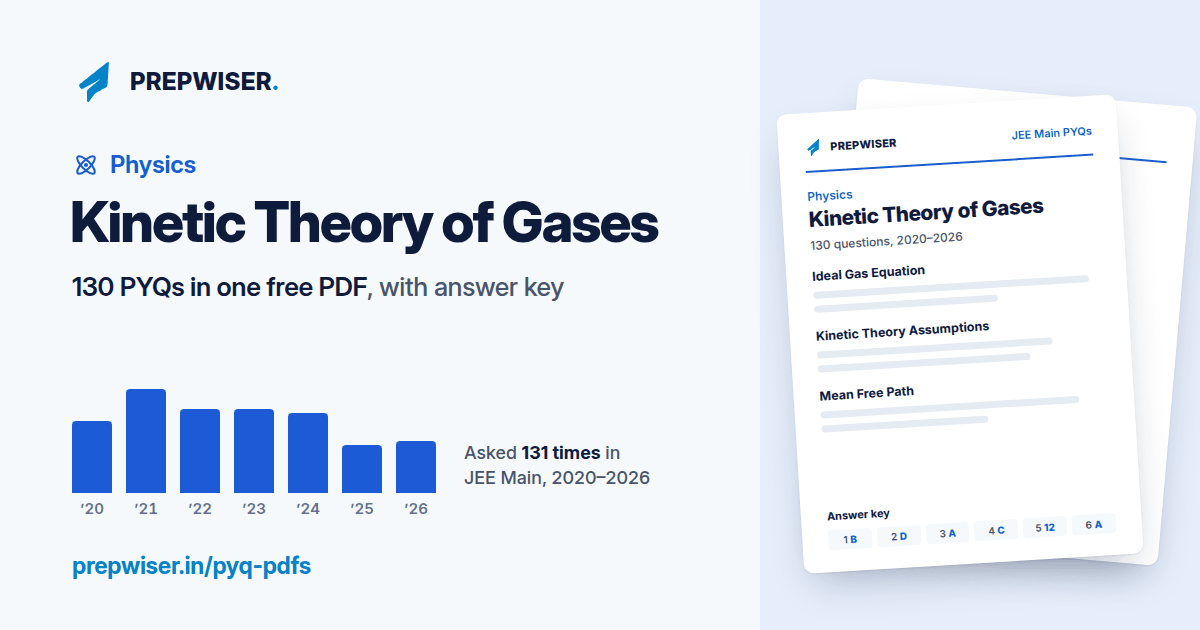
Kinetic Theory of Gases has 131 questions in JEE Main papers from 2020 to 2026, about 19 per year across all shifts. The free PDF has 130 of them, each with its answer. The most asked topic is Degrees of Freedom and Equipartition (55 questions), followed by Ideal Gas Equation (31) and RMS, Average and Most Probable Speed (26).
Asked in JEE Main
1312020–2026, all shifts
In this free PDF
130with answers
Asked in 2026
13Latest paper: 2026 Apr S2
Most asked topic
Degrees of Freedom and Equipartition55 Qs · 42% of the chapter
Difficulty mix
55% easy · 44% medium · 1% hardof the questions in the PDF
10 of this chapter's questions came back in a later paper (2021–2026). See the most repeated.
How often it's asked in JEE Main
Kinetic Theory of Gases had about 0.8 questions per shift in recent JEE Main papers (2024–26). Most asked topic: Degrees of Freedom and Equipartition. About 13 questions in the 2026 papers.
It came up in most 2024–26 shifts in our bank (about 42 shifts). Question types in 2020–2026: about 113 MCQs and about 18 numerical.
How many questions from Kinetic Theory of Gases in JEE Main, year by year
Year
Questions
Per shift
MCQ
Numerical
2026
13
0.7
11
2
2025
12
0.6
9
3
2024
20
1.0
20
0
2023
21
0.9
21
0
2022
21
0.9
17
4
2021
26
1.0
21
5
2020
18
1.1
14
4
2020–2026
131
0.9
113
18
Most asked Kinetic Theory of Gases topics, 2020–2026
Topic
Questions
Degrees of Freedom and Equipartition
55
Ideal Gas Equation
31
RMS, Average and Most Probable Speed
26
Mean Free Path
16
Kinetic Theory Assumptions
3
Counted from PrepWiser's question bank of JEE Main papers, 2020–2026. Per shift = questions that year ÷ shifts in our bank. Updated .
in the free PDF asked, not in the PDFThe PDF only has questions we can print in full with a checked answer, so it holds 130 of the 131 asked.
Topic-wise weightage by year
How many Kinetic Theory of Gases questions each topic had in every JEE Main year (all shifts), counting every question asked, including ones not in the PDF. Darker cells mean more questions.
Topic
Asked
Share
2026
2025
2024
2023
2022
2021
2020
Degrees of Freedom and Equipartition
55
42%
1
6
11
8
8
12
9
Ideal Gas Equation
31
24%
8
3
3
3
5
6
3
RMS, Average and Most Probable Speed
26
20%
1
2
3
8
6
5
1
Mean Free Path
16
12%
2
1
3
2
1
2
5
Kinetic Theory Assumptions
3
2%
1
·
·
·
1
1
·
All topics
131
100%
13
12
20
21
21
26
18
Swipe the table sideways for older years.
Newest questions (2026)
The 12 newest of the 13 JEE Main 2026 Kinetic Theory of Gases questions in the free PDF, latest shift first.
JEE Main 2026 · 6 Apr · Shift 1 · Ideal Gas Equation
Two closed vessels of same volume are joined through a narrow tube and both vessels are filled with air of pressure 90 kPa and temperature 400 K . Keeping the temperature of one vessel constant at 400 K the second vessel temperature is raised to 500 K . The final pressure in the vessels is ____ kPa .
JEE Main 2026 · 6 Apr · Shift 2 · Degrees of Freedom and Equipartition
If 2 mole of an ideal monoatomic gas at temperature T, is mixed with 6 mole of another ideal monoatomic gas at temperature 2T then the temperature of mixture is:
JEE Main 2026 · 4 Apr · Shift 2 · Kinetic Theory Assumptions
Given below are two statements: one is labelled as Assertion A and the other is labelled as Reason R
Assertion A : If the average kinetic energy of H2 and O2 molecules, kept in two different sized containers are same, then their temperatures will be same.
Reason R : The r.m.s speed of H2 and O2 molecules are same at same temperature.
Choose the correct answer from the options given below
JEE Main 2026 · 4 Apr · Shift 1 · Ideal Gas Equation
One gas of n1 mole of molecules at temperature T1, volume V1, and pressure P1, and another gas of n2 mole of molecules at temperature T2, volume V2, and pressure P2, are mixed resulting in pressure P and volume V of the mixture. The temperature of the mixture is ____ .
JEE Main 2026 · 2 Apr · Shift 2 · Ideal Gas Equation
A mixture of carbon dioxide and oxygen has volume 8310 cm3, temperature 300 K, pressure 100 kPa and mass 13.2 g. The number of moles of carbon dioxide and oxygen gases in the mixture respectively are ______.
(Assume both carbon dioxide and oxygen gases behave like ideal gases) [R = 8.31 J/mol K]
The mean free path of a molecule of diameter 5×10⁻¹⁰ m at the temperature 41∘C and pressure 1.38×10⁵ Pa, is given as ________ m. (Given kB=1.38×10⁻²³ J/K).
JEE Main 2026 · 24 Jan · Shift 1 · Ideal Gas Equation
A gas of certain mass filled in a closed cylinder at a pressure of 3.23 kPa has temperature 50∘C. The gas is now heated to double its temperature on the Celsius scale. The modified pressure is ____ Pa .
JEE Main 2026 · 23 Jan · Shift 2 · Ideal Gas Equation
An air bubble of volume 2.9cm3 rises from the bottom of a swimming pool of 5 m deep. At the bottom of the pool water temperature is 17∘C. The volume of the bubble when it reaches the surface, where the water temperature is 27∘C, is ____cm3.
( g=10m/s2, density of water =103kg/m3, and 1 atm pressure is 105Pa )
JEE Main 2026 · 22 Jan · Shift 2 · Ideal Gas Equation
An insulated cylinder of volume 60cm3 is filled with a gas at 27∘C and 2 atmospheric pressure. Then the gas is compressed making the final volume as 20cm3 while allowing the temperature to rise to 77∘C. The final pressure is ____ atmospheric pressure.
Consider two boxes containing ideal gases A and B such that their temperatures, pressures and number densities are same. The molecular size of A is half of that of B and mass of molecule A is four times that of B. If the collision frequency in gas B is 32×1018/s then collision frequency in gas A is ____ /s.
JEE Main 2026 · 22 Jan · Shift 1 · Ideal Gas Equation
A cylindrical tube AB of length l, closed at both ends contains an ideal gas of 1 mol having molecular weight M. The tube is rotated in a horizontal plane with constant angular velocity ω about an axis perpendicular to AB and passing through the edge at end A, as shown in the figure. If PA and PB are the pressures at A and B respectively, then (Consider the temperature is same at all points in the tube)
JEE Main 2026 · 21 Jan · Shift 2 · RMS, Average and Most Probable Speed
The r.m.s. speed of oxygen molecules at 47 °C is equal to that of the hydrogen molecules kept at _________ °C. (Mass of oxygen molecule/mass of hydrogen molecule = 32/2)
JEE Main 2025 · 7 Apr · Shift 2 · Degrees of Freedom and Equipartition
The helium and argon are put in the flask at the same room temperature (300 K). The ratio of average kinetic energies (per molecule) of helium and argon is:
(Give: Molar mass of helium = 4 g/mol, Molar mass of argon = 40 g/mol)
The mean free path and the average speed of oxygen molecules at 300 K and 1 atm are 3×10⁻⁷m and 600m/s, respectively. Find the frequency of its collisions.
How many questions come from Kinetic Theory of Gases in JEE Main?
131 questions from 2020 to 2026, about 19 per year. In 2026 it had 13. The free PDF has 130 of them.
Which Kinetic Theory of Gases topics are most important for JEE Main?
By past papers: Degrees of Freedom and Equipartition (42%), Ideal Gas Equation (24%) and RMS, Average and Most Probable Speed (20%) of all Kinetic Theory of Gases questions.
Is the Kinetic Theory of Gases PYQ PDF free?
Yes. The PDF and its answer key are free, and you can practise the questions online with no login, with step-by-step solutions where available.
Answers follow NTA's final answer keys. Typing errors are possible, so check doubtful answers against the official key. Spotted a mistake? prepwiser.in/feedback · Terms: prepwiser.in/terms