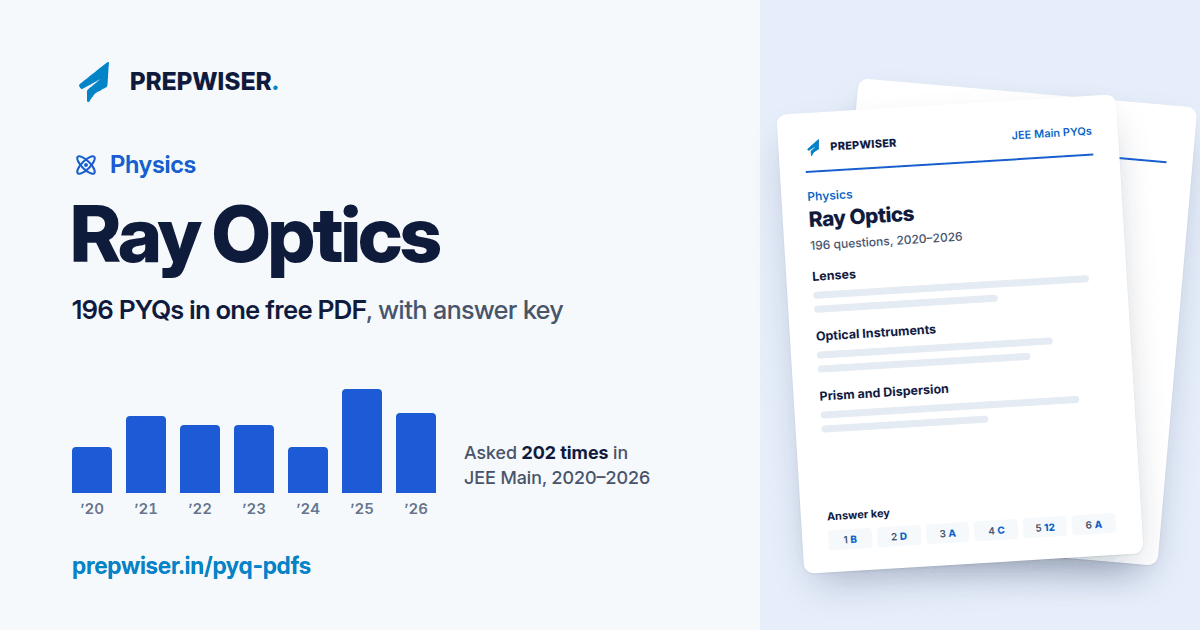
Ray Optics has 202 questions in JEE Main papers from 2020 to 2026, about 29 per year across all shifts. The free PDF has 196 of them, each with its answer. The most asked topic is Lenses (68 questions), followed by Prism and Dispersion (31) and Reflection and Mirrors (31).
Asked in JEE Main
2022020–2026, all shifts
In this free PDF
196with answers
Asked in 2026
33Latest paper: 2026 Apr S2
Most asked topic
Lenses68 Qs · 34% of the chapter
Difficulty mix
37% easy · 60% medium · 3% hardof the questions in the PDF
12 of this chapter's questions came back in a later paper (2021–2026). See the most repeated.
How often it's asked in JEE Main
Ray Optics had about 1.6 questions per shift in recent JEE Main papers (2024–26). It's one of the most asked Physics chapters. Most asked topic: Lenses. About 33 questions in the 2026 papers.
It came up in almost every 2024–26 shift in our bank (about 53 shifts). Question types in 2020–2026: about 137 MCQs and about 65 numerical.
How many questions from Ray Optics in JEE Main, year by year
Year
Questions
Per shift
MCQ
Numerical
2026
33
1.7
26
7
2025
43
2.3
37
6
2024
19
1.0
13
6
2023
28
1.2
13
15
2022
28
1.2
15
13
2021
32
1.2
22
10
2020
19
1.2
11
8
2020–2026
202
1.4
137
65
Most asked Ray Optics topics, 2020–2026
Topic
Questions
Lenses
68
Prism and Dispersion
31
Reflection and Mirrors
31
Refraction and Snell's Law
29
Total Internal Reflection
17
Every topic, year by year, is in the topic-wise table further down.
Counted from PrepWiser's question bank of JEE Main papers, 2020–2026. Per shift = questions that year ÷ shifts in our bank. Updated .
Ray Optics complete chapter, animated, for JEE Main 2027 and Class 12 Physics (NCERT Ch 9). Mirrors, refraction, total internal reflection, lenses, prism, microscope and telescope, each built from one clear idea with worked examples.
in the free PDF asked, not in the PDFThe PDF only has questions we can print in full with a checked answer, so it holds 196 of the 202 asked.
Topic-wise weightage by year
How many Ray Optics questions each topic had in every JEE Main year (all shifts), counting every question asked, including ones not in the PDF. Darker cells mean more questions.
Topic
Asked
Share
2026
2025
2024
2023
2022
2021
2020
Lenses
68
34%
15
16
9
8
7
7
6
Prism and Dispersion
31
15%
8
4
4
2
4
8
1
Reflection and Mirrors
31
15%
3
8
2
6
2
7
3
Refraction and Snell's Law
29
14%
1
5
2
8
8
3
2
Total Internal Reflection
17
9%
3
3
1
1
5
2
2
Optical Instruments
14
7%
3
1
·
2
1
3
4
Refraction at Spherical Surface
12
6%
·
6
1
1
1
2
1
All topics
202
100%
33
43
19
28
28
32
19
Swipe the table sideways for older years.
Newest questions (2026)
The 12 newest of the 32 JEE Main 2026 Ray Optics questions in the free PDF, latest shift first. The 2026 papers asked 33 in all.
JEE Main 2026 · 8 Apr · Shift 2 · Lenses
A thin biconvex lens is prepared from the glass (μ=1.5) both curved surfaces of which have equal radii of 20 cm each. Left side surface of the lens is silvered from outside to make it reflecting. To have the position of image and object at the same place, the object should be placed, from the lens at a distance of ____ cm.
A spherical interface lens of radius R separates two media of refractive indices 1 and 1.4 respectively as shown in the figure below. A point source is placed at a distance of 4R in front of spherical interface. The magnitude of the magnification of point source image is ____ .
JEE Main 2026 · 6 Apr · Shift 2 · Reflection and Mirrors
A concave mirror of focal length 10 cm forms an image which is double the size of object when the object is placed at two different positions. The distance between the two positions of the object is
A compound microscope is designed with two symmetric biconvex lenses. The objective lens is cut vertically, creating two identical plano-convex lenses. One of them is used in place of original objective lens. To retain same magnification keeping the object distance unchanged, the tube length has to be
An object AB is placed 15 cm on the left of a convex lens P of focal length 10 cm . Another convex lens Q is now placed 15 cm right of lens P. If the focal length of lens Q is 15 cm , the final image is ____ .
A thin convex lens and a thin concave lens are kept in contact and are co-axial. Which of the following statements is correct for this combination of two lenses ?
A convex lens is made from glass material having refractive index of 1.4 with same radius of curvature on both sides. The ratio of its focal length and radius of curvature is ____ .
JEE Main 2026 · 2 Apr · Shift 2 · Total Internal Reflection
One side of an equilateral prism is painted by a transparent material of refractive index n2. The refractive index of prism is 1.6. The minimum value of n2 required for total internal reflection from painted face is ________.
JEE Main 2026 · 24 Jan · Shift 1 · Optical Instruments
In a microscope of tube length 10 cm two convex lenses are arranged with focal length of 2 cm and 5 cm . Total magnification obtained with this system for normal adjustment is (5)k. The value of k is ____ .
JEE Main 2025 · 8 Apr · Shift 2 · Refraction at Spherical Surface
A concave-convex lens of refractive index 1.5 and the radii of curvature of its surfaces are 30 cm and 20 cm, respectively. The concave surface is upwards and is filled with a liquid of refractive index 1.3. The focal length of the liquid-glass combination will be
JEE Main 2025 · 7 Apr · Shift 1 · Refraction and Snell's Law
A container contains a liquid with refractive index of 1.2 up to a height of 60 cm and another liquid having refractive index 1.6 is added to height H above first liquid. If viewed from above, the apparent shift in the position of bottom of container is 40 cm . The value of H is ________ cm . (Consider liquids are immisible)
Answers follow NTA's final answer keys. Typing errors are possible, so check doubtful answers against the official key. Spotted a mistake? prepwiser.in/feedback · Terms: prepwiser.in/terms