PREPWISER.

Halogen Derivatives: Haloalkanes & Haloarenes JEE Main PYQs PDF, 2020–2026

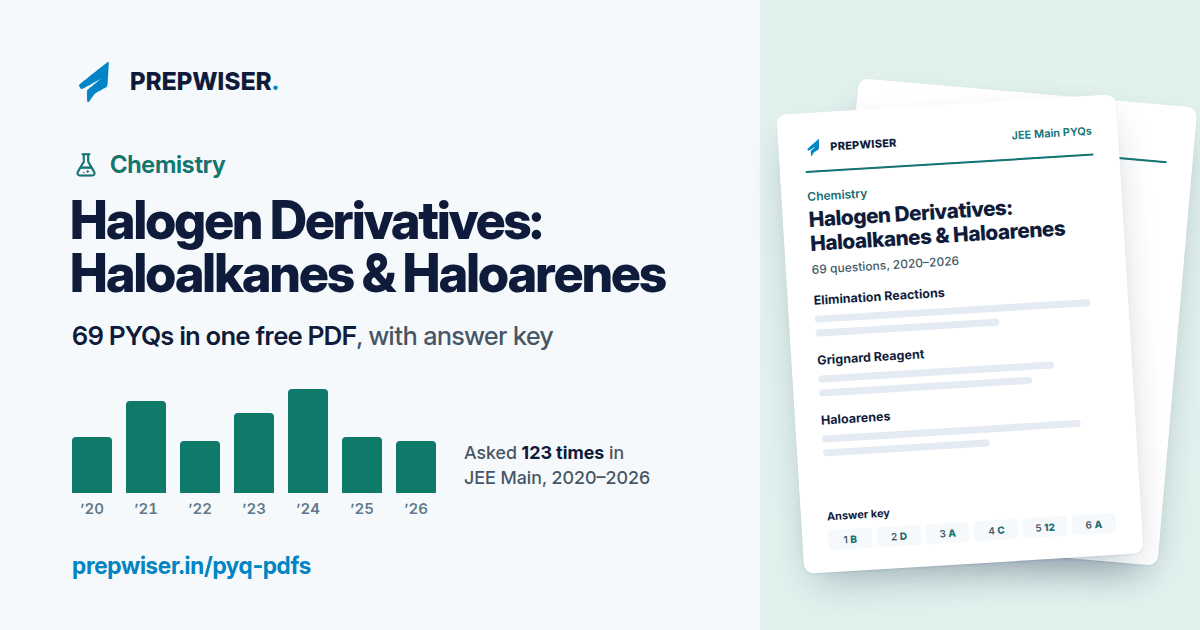
Halogen Derivatives: Haloalkanes & Haloarenes has 123 questions in JEE Main papers from 2020 to 2026, about 18 per year across all shifts. The free PDF has 69 of them, each with its answer. The most asked topic is SN1 and SN2 Mechanisms (49 questions), followed by Grignard Reagent (24) and Elimination Reactions (21).

Asked in JEE Main
1232020–2026, all shifts
In this free PDF
69with answers
Asked in 2026
13Latest paper: 2026 Apr S2
Most asked topic
SN1 and SN2 Mechanisms49 Qs · 40% of the chapter
Difficulty mix
25% easy · 72% medium · 3% hardof the questions in the PDF

Answer key includedNo loginPractise online

Source: official NTA JEE Main papers · Updated

Practise these 69 questions free, no login Download PDF (0.6 MB)

How often it's asked in JEE Main

Halogen Derivatives: Haloalkanes & Haloarenes had about 0.7 questions per shift in recent JEE Main papers (2024–26). Its share has risen since 2020–22. Most asked topic: SN1 and SN2 Mechanisms. About 13 questions in the 2026 papers.

It came up in most 2024–26 shifts in our bank (about 41 shifts). Question types in 2020–2026: about 114 MCQs and about 9 numerical.

How many questions from Halogen Derivatives: Haloalkanes & Haloarenes in JEE Main, year by year

YearQuestionsPer shiftMCQNumerical
2026130.7121
2025140.7140
2024261.3233
2023200.8191
2022130.6112
2021230.9221
2020140.9131
2020–20261230.81149

Most asked Halogen Derivatives: Haloalkanes & Haloarenes topics, 2020–2026

TopicQuestions
SN1 and SN2 Mechanisms49
Grignard Reagent24
Elimination Reactions21
Haloarenes15
Preparation of Haloalkanes11

Every topic, year by year, is in the topic-wise table further down.

Counted from PrepWiser's question bank of JEE Main papers, 2020–2026. Per shift = questions that year ÷ shifts in our bank. Updated .

Download these numbers (CSV)

See all chapters' weightage →

Revise Halogen Derivatives: Haloalkanes & Haloarenes before you practise

Two free sheets, made from the past JEE Main questions on this chapter.

Share card for Halogen Derivatives: Haloalkanes & Haloarenes: JEE Main PYQs with answers, free PDF

Send this chapter to your study group

The link opens this page: the free PDF with 69 questions and answers, and online practice. Nobody needs to log in.

Halogen Derivatives: Haloalkanes & Haloarenes questions per year

YearAskedIn PDF
20261313
20251410
20242614
20232010
2022134
2021239
2020149

in the free PDF asked, not in the PDFThe PDF only has questions we can print in full with a checked answer, so it holds 69 of the 123 asked.

Topic-wise weightage by year

How many Halogen Derivatives: Haloalkanes & Haloarenes questions each topic had in every JEE Main year (all shifts), counting every question asked, including ones not in the PDF. Darker cells mean more questions.

TopicAskedShare2026202520242023202220212020
SN1 and SN2 Mechanisms4940%86119546
Grignard Reagent2420%1234491
Elimination Reactions2117%·262146
Haloarenes1512%1224141
Preparation of Haloalkanes119%322·22·
Polyhalogen Compounds32%··21···
All topics123100%13142620132314

Swipe the table sideways for older years.

Newest questions (2026)

The 12 newest of the 13 JEE Main 2026 Halogen Derivatives: Haloalkanes & Haloarenes questions in the free PDF, latest shift first.

  1. JEE Main 2026 · 8 Apr · Shift 2 · Preparation of Haloalkanes

    Given below are two statements :

    Statement I : Due to increase in van der Waals forces, the order of boiling points is CH3CH2CH2I>CH3CH2I>CH3I{\mathrm{CH}}_{3}{\mathrm{CH}}_{2}{\mathrm{CH}}_{2}{\mathrm{I}}>{\mathrm{CH}}_{3}{\mathrm{CH}}_{2}{\mathrm{I}}>{\mathrm{CH}}_{3}{\mathrm{I}}.

    Statement II:\text{ Statement II:}JEE Main PYQ figure

    In the light of the above statements, choose the correct answer from the options given below :

    Solve it online →
  2. JEE Main 2026 · 6 Apr · Shift 1 · SN1 and SN2 Mechanisms

    Given below are two statements :

    Statement I : 3-phenylpropene reacts with HBr and gives secondary alkyl bromide having a chiral carbon atom as the major product.

    Statement II : Aryl chlorides and aryl cyanides can be prepared by Sandmeyer reaction as well as Gattermann reaction.

    In the light of the above statements, choose the correct answer from the options given below

    Solve it online →
  3. JEE Main 2026 · 4 Apr · Shift 1 · Preparation of Haloalkanes

    Match the LIST-I with LIST-II\text{ Match the LIST-I with LIST-II}

    List-I Name of reaction\begin{array}{c}\text{ List-I} \\ \text{ Name of reaction}\end{array}
    List-II Reagent or catalyst used\begin{array}{c}\text{ List-II} \\ \text{ Reagent or catalyst used}\end{array}
    A. Finkelstein reaction I. SbF3{\mathrm{SbF}}_{3}
    B. Swarts reaction II. Na, dry ether
    C. Sandmeyer's reaction III. NaI
    D. Fittig reaction IV. Cu2Cl2{\mathrm{Cu}}_{2}{\mathrm{Cl}}_{2}

    Choose the correct answer from the options given below :

    Solve it online →
  4. JEE Main 2026 · 2 Apr · Shift 2 · SN1 and SN2 Mechanisms

    Correct statements regarding alkyl halides (R–X) among the following are :

    A. Alcohol being less polar solvent as compared to water, alcoholic KOH favours elimination reaction with R–X.

    B. Order of reactivity towards SN1 mechanism is C6H5–CH2–Cl > C6H5–CHCl–C6H5.

    C. Non substituted aryl halides exhibit properties similar to alkyl halides.

    D. Vinyl chloride is an example of haloalkene and allyl chloride is an example of haloalkyne.

    E. R–Cl can be prepared by reacting R–OH with SOCl2 but Ar–Cl cannot be prepared by reacting Ar–OH with SOCl2.

    Choose the correct answer from the options given below :

    Solve it online →
  5. JEE Main 2026 · 2 Apr · Shift 1 · SN1 and SN2 Mechanisms

    Given below are two statements :

    Statement (I) : Benzyl chloride reacts faster in SN1S_N1 mechanism than ethyl chloride.

    Statement (II) : Ethyl carbocation intermediate is less stabilized by hyperconjugation than benzyl carbocation by resonance.

    In the light of the above statements, choose the correct answer from the options given below :

    Solve it online →
  6. JEE Main 2026 · 24 Jan · Shift 2 · Grignard Reagent

    Grignard reagent RMgBr(P){\mathrm{RMgBr}}({\mathrm{P}}) reacts with water and forms a gas (Q)({\mathrm{Q}}). One gram of Q occupies 1.4dm31.4{\mathrm{dm}}^{3} at STP. (P) on reaction with dry ice in dry ether followed by H3O+{\mathrm{H}}_{3}{\mathrm{O}}^{{+}}forms a compound (Z). 0.1 mole of (Z) will weigh ____\_\_\_\_ g. (Nearest integer)

    Solve it online →
  7. JEE Main 2026 · 24 Jan · Shift 1 · Preparation of Haloalkanes

    Match the List-I with List-II

    List-I
    Chloro derivative
    List-II
    Example
    A. Vinyl ChlorideI. CH2_2 = CH - CH2_2Cl
    B. Benzyl ChlorideII. CH3_3 - CH(Cl)CH3_3
    C. Alkyl ChlorideIII. CH2_2 = CHCl
    D. Allyl ChlorideIV. JEE Main PYQ figure

    Choose the correct answer from the options given below :

    Solve it online →
  8. JEE Main 2026 · 24 Jan · Shift 1 · SN1 and SN2 Mechanisms

    Given below are two statements :

    Statement I : ' C−Cl\mathrm{C}-\mathrm{Cl} ' bond is stronger in CH2=CH−Cl\mathrm{CH}_2=\mathrm{CH}-\mathrm{Cl} than CH3−CH2−Cl\mathrm{CH}_3-\mathrm{CH}_2-\mathrm{Cl}

    Statement II : The given optically active molecule, JEE Main PYQ figure on

    hydrolysis gives a solution that can rotate the plane polarized light.

    In the light of the above statements, choose the correct answer from the options given below

    Solve it online →
  9. JEE Main 2026 · 22 Jan · Shift 1 · Haloarenes

    As compared with chlorocyclohexane, which of the following statements correctly apply to chlorobenzene?

    A. The magnitude of negative charge is more on chlorine atom.

    B. The C−Cl\mathrm{C}-\mathrm{Cl} bond has partial double bond character.

    C. C−Cl\mathrm{C}-\mathrm{Cl} bond is less polar.

    D. C−Cl\mathrm{C}-\mathrm{Cl} bond is longer due to repulsion between delocalised electrons of the aromatic ring and lone pairs of electrons of chlorine.

    E. The C−Cl\mathrm{C}-\mathrm{Cl} bond is formed using sp2\mathrm{sp}^2 hybridised orbital of carbon.

    Choose the correct answer from the options given below :

    Solve it online →
  10. JEE Main 2026 · 22 Jan · Shift 1 · SN1 and SN2 Mechanisms

    The correct order of the rate of reaction of the following reactants with nucleophile by SN1\mathrm{S}_{\mathrm{N}} 1 mechanism is :

    (Given : Structures I and II are rigid)

    JEE Main PYQ figure
    Solve it online →
  11. JEE Main 2026 · 22 Jan · Shift 1 · SN1 and SN2 Mechanisms

    The correct order of reactivity of CH3Br\mathrm{CH}_3 \mathrm{Br} in methanol with the following nucleophiles is

    F−,I−,C2H5O−\mathrm{F}^{-}, \mathrm{I}^{-}, \mathrm{C}_2 \mathrm{H}_5 \mathrm{O}^{-}and C6H5O−\mathrm{C}_6 \mathrm{H}_5 \mathrm{O}^{-}

    Solve it online →
  12. JEE Main 2026 · 21 Jan · Shift 2 · SN1 and SN2 Mechanisms

    The correct order of the rate of the reaction for the following reaction with respect to nucleophiles is :

    CH3Br+Nu−⟶CH3Nu+Br−{CH_{3}Br+Nu^{-}\longrightarrow CH_{3}Nu+Br^{-}}

    Solve it online →

Practise the 2026 Halogen Derivatives: Haloalkanes & Haloarenes questions online

Sample questions from recent papers

JEE Main 2025 · 7 Apr · Shift 2 · Haloarenes

Match List - I with List - II.

List - I (Conversion) List - II (Reagents, Conditions used)
JEE Main PYQ figure (I) Warm H2O
JEE Main PYQ figure (II) (a) NaOH, 368K; (b) H3O+
JEE Main PYQ figure (III) (a) NaOH, 443K; (b) H3O+
JEE Main PYQ figure (IV) (a) NaOH, 623K, 300 atm; (b) H3O+

Choose the correct answer from the options given below :

  1. (A)

    (A)-(II), (B)-(III), (C)-(I), (D)-(IV)

  2. (B)

    (A)-(III), (B)-(IV), (C)-(II), (D)-(I)

  3. (C)

    (A)-(IV), (B)-(III), (C)-(I), (D)-(II)

  4. (D)

    (A)-(IV), (B)-(III), (C)-(II), (D)-(I)

Show answerHide answer

Answer: (D)

Solve online

JEE Main 2025 · 4 Apr · Shift 1 · Grignard Reagent

An organic compound (X)(\mathrm{X}) with molecular formula C3H6O\mathrm{C}_3 \mathrm{H}_6 \mathrm{O} is not readily oxidised. On reduction it gives C3H8O(Y)\mathrm{C}_3 \mathrm{H}_8 \mathrm{O}(\mathrm{Y}) which reacts with HBr to give a bromide (Z)(\mathrm{Z}) which is converted to Grignard reagent. This Grignard reagent on reaction with (X)(\mathrm{X}) followed by hydrolysis give 2,3-dimethylbutan-2-ol. Compounds (X),(Y)(\mathrm{X}),(\mathrm{Y}) and (Z)(\mathrm{Z}) respectively are:

  1. (A) CH3CH2CHO,CH3CH2CH2OH,CH3CH2CH2Br\mathrm{CH}_3 \mathrm{CH}_2 \mathrm{CHO}, \mathrm{CH}_3 \mathrm{CH}_2 \mathrm{CH}_2 \mathrm{OH}, \mathrm{CH}_3 \mathrm{CH}_2 \mathrm{CH}_2 \mathrm{Br}
  2. (B) CH3COCH3,CH3CH(OH)CH3,CH3CH(Br)CH3\mathrm{CH}_3 \mathrm{COCH}_3, \mathrm{CH}_3 \mathrm{CH}(\mathrm{OH}) \mathrm{CH}_3, \mathrm{CH}_3 \mathrm{CH}(\mathrm{Br}) \mathrm{CH}_3
  3. (C) CH3COCH3,CH3CH2CH2OH,CH3CH(Br)CH3\mathrm{CH}_3 \mathrm{COCH}_3, \mathrm{CH}_3 \mathrm{CH}_2 \mathrm{CH}_2 \mathrm{OH}, \mathrm{CH}_3 \mathrm{CH}(\mathrm{Br}) \mathrm{CH}_3
  4. (D) CH3CH2CHO,CH3CH=CH2,CH3CH(Br)CH3\mathrm{CH}_3 \mathrm{CH}_2 \mathrm{CHO}, \mathrm{CH}_3 \mathrm{CH}=\mathrm{CH}_2, \mathrm{CH}_3 \mathrm{CH}(\mathrm{Br}) \mathrm{CH}_3
Show answerHide answer

Answer: (B)

Solve online

JEE Main 2025 · 4 Apr · Shift 2 · Elimination Reactions

Given below are two statements :

Statement (I) : Alcohols are formed when alkyl chlorides are treated with aqueous potassium hydroxide by elimination reaction.

Statement (II) : In alcoholic potassium hydroxide, alkyl chlorides form alkenes by abstracting the hydrogen from the β\beta-carbon.

In the light of the above statements, choose the most appropriate answer from the options given below :

  1. (A) Both Statement I and Statement II are incorrect
  2. (B) Both Statement I and Statement II are correct
  3. (C) Statement I is incorrect but Statement II is correct
  4. (D) Statement I is correct but Statement II is incorrect
Show answerHide answer

Answer: (C)

Solve online

JEE Main 2024 · 6 Apr · Shift 1 · Polyhalogen Compounds

Match List I with List II

LIST I
(Compound)
LIST II
(Uses)
A. Idoform I. Fire extinguisher
B. Carbon tetrachloride II. Insecticide
C. CFC III. Antiseptic
D. DDT IV. Refrigerants

Choose the correct answer from the options given below:

  1. (A)A-II, B-IV, C-I, D-III
  2. (B)A-III, B-I, C-IV, D-II
  3. (C)A-III, B-II, C-IV, D-I
  4. (D)A-I, B-II, C-III, D-IV
Show answerHide answer

Answer: (B)

Solve online

The free PDF above has all 69 questions grouped by topic, with an answer key.

Practise these online, free, no login

Answer Halogen Derivatives: Haloalkanes & Haloarenes PYQs in the browser, get each one checked instantly and open the step-by-step solution where there is one.

Practise Halogen Derivatives: Haloalkanes & Haloarenes online

Frequently asked

How many questions come from Halogen Derivatives: Haloalkanes & Haloarenes in JEE Main?

123 questions from 2020 to 2026, about 18 per year. In 2026 it had 13. The free PDF has 69 of them.

Which Halogen Derivatives: Haloalkanes & Haloarenes topics are most important for JEE Main?

By past papers: SN1 and SN2 Mechanisms (40%), Grignard Reagent (20%) and Elimination Reactions (17%) of all Halogen Derivatives: Haloalkanes & Haloarenes questions.

Is the Halogen Derivatives: Haloalkanes & Haloarenes PYQ PDF free?

Yes. The PDF and its answer key are free, and you can practise the questions online with no login, with step-by-step solutions where available.

More Chemistry chapters

JEE Main PYQs by year: 2026 · 2025 · 2024 · 2023 · 2022 · 2021 · 2020

Answers follow NTA's final answer keys. Typing errors are possible, so check doubtful answers against the official key. Spotted a mistake? prepwiser.in/feedback · Terms: prepwiser.in/terms