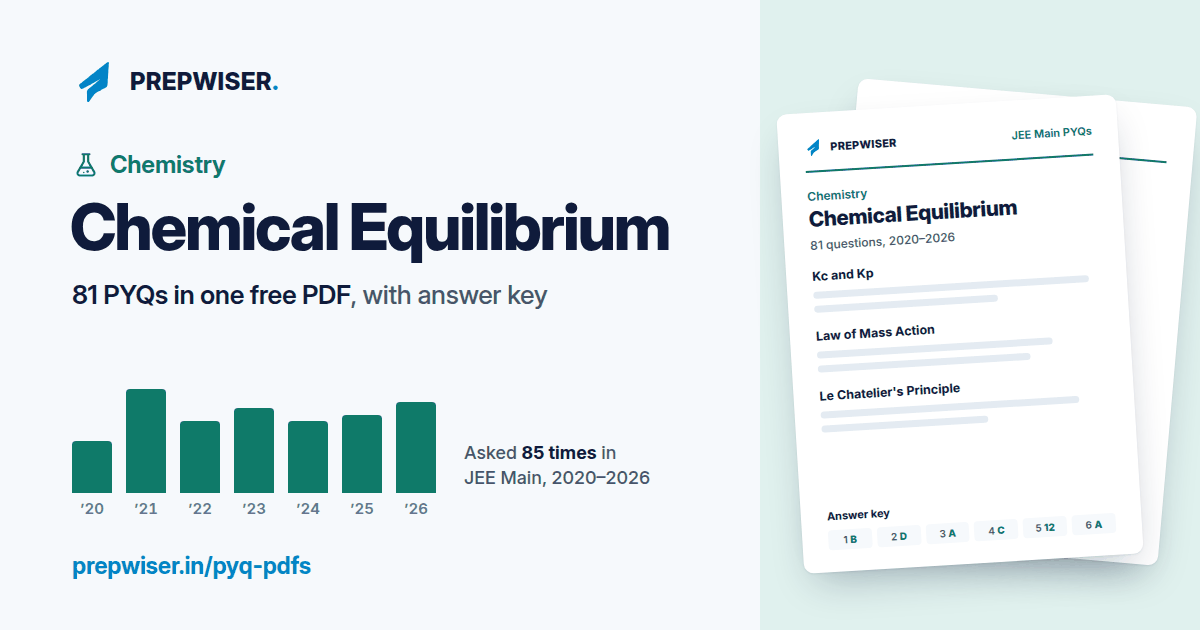
Chemical Equilibrium has 85 questions in JEE Main papers from 2020 to 2026, about 12 per year across all shifts. The free PDF has 81 of them, each with its answer. The most asked topic is Law of Mass Action (72 questions), followed by Le Chatelier's Principle (11) and Kc and Kp (2).
3 of this chapter's questions came back in a later paper (2021–2026). See the most repeated.
How often it's asked in JEE Main
Chemical Equilibrium had about 0.6 questions per shift in recent JEE Main papers (2024–26). Most asked topic: Law of Mass Action. About 14 questions in the 2026 papers.
It came up in most 2024–26 shifts in our bank (about 33 shifts). Question types in 2020–2026: about 36 MCQs and about 49 numerical.
How many questions from Chemical Equilibrium in JEE Main, year by year
Year
Questions
Per shift
MCQ
Numerical
2026
14
0.7
7
7
2025
12
0.6
9
3
2024
11
0.6
8
3
2023
13
0.5
2
11
2022
11
0.5
3
8
2021
16
0.6
0
16
2020
8
0.5
7
1
2020–2026
85
0.6
36
49
Most asked Chemical Equilibrium topics, 2020–2026
Topic
Questions
Law of Mass Action
72
Le Chatelier's Principle
11
Kc and Kp
2
Counted from PrepWiser's question bank of JEE Main papers, 2020–2026. Per shift = questions that year ÷ shifts in our bank. Updated .
in the free PDF asked, not in the PDFThe PDF only has questions we can print in full with a checked answer, so it holds 81 of the 85 asked.
Topic-wise weightage by year
How many Chemical Equilibrium questions each topic had in every JEE Main year (all shifts), counting every question asked, including ones not in the PDF. Darker cells mean more questions.
Topic
Asked
Share
2026
2025
2024
2023
2022
2021
2020
Law of Mass Action
72
85%
13
9
8
9
10
15
8
Le Chatelier's Principle
11
13%
1
3
2
4
1
·
·
Kc and Kp
2
2%
·
·
1
·
·
1
·
All topics
85
100%
14
12
11
13
11
16
8
Swipe the table sideways for older years.
Newest questions (2026)
The 12 newest of the 14 JEE Main 2026 Chemical Equilibrium questions in the free PDF, latest shift first.
JEE Main 2026 · 8 Apr · Shift 2 · Law of Mass Action
Solid carbon, CaO and CaCO3 are mixed and allowed to attain equilibrium at T K .
JEE Main 2026 · 6 Apr · Shift 2 · Law of Mass Action
In a closed flask at 600 K , one mole of X2Y4(g) attains equilibrium as given below :
X2Y4(g)⇌2XY2(g)
At equilibrium, 75%X2Y4(g) was dissociated and the total pressure is 1 atm . The magnitude of ΔrG⊖ (in kJmol−1 ) at this temperature is ____ . (Nearest Integer)
JEE Main 2026 · 5 Apr · Shift 1 · Law of Mass Action
The values of pressure equilibrium constant recorded at different temperatures for the following equilibrium reaction have been given below A(g)⇌B(g)+C(g)
T1(K−1)0.050.060.07log10Kp3.52.51.5
The magnitude of RΔH∘ calculated from the above data is ____ . (Nearest integer)
JEE Main 2026 · 5 Apr · Shift 2 · Law of Mass Action
The reaction A(g)⇌B(g)+C(g) was initiated with the amount ' a ' of A(g). At equilibrium it is found that the amount of A(g) remaining is ( a−x ) at a total pressure of p .
The equilibrium constant Kp of the reaction can be calculated from the expression :
JEE Main 2026 · 28 Jan · Shift 2 · Law of Mass Action
Observe the following equilibrium in a 1 L flask.
A(g) ⇌ B(g)
At T(K), the equilibrium concentrations of A and B are 0.5 M and 0.375 M respectively. 0.1 moles of A is added into the flask and heated to T(K) to establish the equilibrium again. The new equilibrium concentrations (in M) of A and B are respectively
JEE Main 2026 · 24 Jan · Shift 2 · Le Chatelier's Principle
Consider the following gaseous equilibrium in a closed container of volume ' V ' at T(K).
P2(g)+Q2(g)⇌2PQ(g)
2 moles each of P2(g),Q2(g) and PQ(g) are present at equilibrium. Now one mole each of ' P2 ' and ' Q2 ' are added to the equilibrium keeping the temperature at T(K). The number of moles of P2,Q2 and PQ at the new equilibrium, respectively, are
JEE Main 2026 · 23 Jan · Shift 1 · Law of Mass Action
For the following gas phase equilibrium reaction at constant temperature,
NH3(g)⇌1/2N2(g)+3/2H2(g)
if the total pressure is 3atm and the pressure equilibrium constant (Kp) is 9 atm , then the degree of dissociation is given as (x×10−2)−1/2. The value of x is ____ . (nearest integer)
Answers follow NTA's final answer keys. Typing errors are possible, so check doubtful answers against the official key. Spotted a mistake? prepwiser.in/feedback · Terms: prepwiser.in/terms