PREPWISER.

Polymers JEE Main PYQs PDF, 2020–2025

This chapter was removed from the JEE Main syllabus in 2024. These are older PYQs. See what changed →

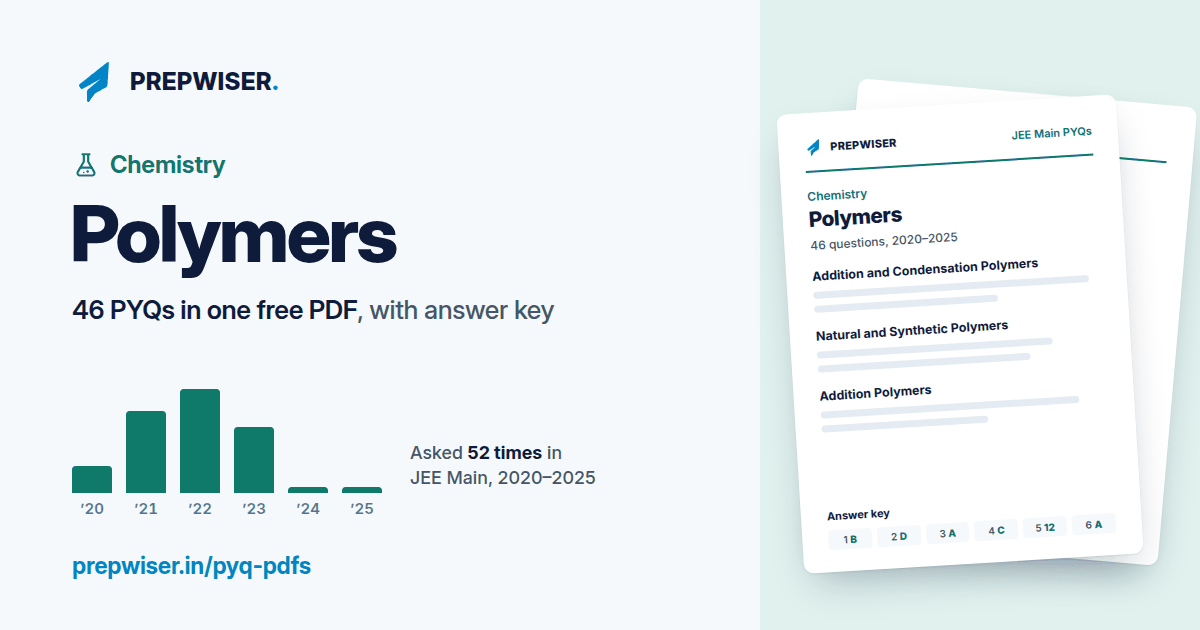
Polymers has 52 questions in JEE Main papers from 2020 to 2025, about 8.7 per year across all shifts. The free PDF has 46 of them, each with its answer. The most asked topic is Condensation Polymers (14 questions), followed by Addition Polymers (11) and Addition and Condensation Polymers (9).

Asked in JEE Main
522020–2025, all shifts
In this free PDF
46with answers
Asked in 2025
1Latest paper: 2025 Apr S2
Most asked topic
Condensation Polymers14 Qs · 27% of the chapter
Difficulty mix
87% easy · 13% mediumof the questions in the PDF

Answer key includedNo loginPractise online

Source: official NTA JEE Main papers · Updated

Practise these 46 questions free, no login Download PDF (0.2 MB)

1 of this chapter's questions came back in a later paper (2021–2026). See the most repeated.

How often it's asked in JEE Main

Polymers was removed from the JEE Main syllabus in 2024. It had about 0.5 questions per shift in 2020–22 and none since.

It came up in about one of the 2024–26 shifts in our bank. Question types in 2020–2026: about 51 MCQs and about 1 numerical.

How many questions from Polymers in JEE Main, year by year

YearQuestionsPer shiftMCQNumerical
20260000
20251<0.110
20240000
2023120.5120
2022190.8181
2021150.6150
202050.350
2020–2026520.4511

Most asked Polymers topics, 2020–2026

TopicQuestions
Condensation Polymers14
Addition Polymers11
Addition and Condensation Polymers9
Classification of Polymers9
Natural and Synthetic Polymers7

Every topic, year by year, is in the topic-wise table further down.

Counted from PrepWiser's question bank of JEE Main papers, 2020–2026. Per shift = questions that year ÷ shifts in our bank. Updated .

Download these numbers (CSV)

See what was removed in 2024 →

Share card for Polymers: JEE Main PYQs with answers, free PDF

Send this chapter to your study group

The link opens this page: the free PDF with 46 questions and answers, and online practice. Nobody needs to log in.

Polymers questions per year

YearAskedIn PDF
202511
202400
20231212
20221915
20211513
202055

in the free PDF asked, not in the PDFThe PDF only has questions we can print in full with a checked answer, so it holds 46 of the 52 asked.

Topic-wise weightage by year

How many Polymers questions each topic had in every JEE Main year (all shifts), counting every question asked, including ones not in the PDF. Darker cells mean more questions.

TopicAskedShare202520242023202220212020
Condensation Polymers1427%··1571
Addition Polymers1121%··3341
Addition and Condensation Polymers917%··3411
Classification of Polymers917%··441·
Natural and Synthetic Polymers714%1·1311
Biodegradable Polymers24%····11
All topics52100%101219155

Swipe the table sideways for older years.

Newest questions (2025)

The only JEE Main 2025 Polymers question in the free PDF.

  1. JEE Main 2025 · 3 Apr · Shift 2 · Natural and Synthetic Polymers

    Given below are two statements:

    Statement I : Wet cotton clothes made of cellulose based carbohydrate takes comparatively longer time to get dried than wet nylon polymer based clothes.

    Statement II : Intermolecular hydrogen bonding with water molecule is more in nylon-based clothes than in the case of cotton clothes.

    In the light of above statements, choose the correct answer from the options given below

    Solve it online →

Practise the 2025 Polymers questions online

Sample questions from recent papers

JEE Main 2023 · 15 Apr · Shift 1 · Addition and Condensation Polymers

Match List I with List II:

List I - (Monomer) List II - (Polymer)
(A) Tetrafluoroethene (I) Orlon
(B) Acrylonitrile (II) Natural rubber
(C) Caprolactam (III) Teflon
(D) Isoprene (IV) Nylon-6

Choose the correct answer from the options given below :
  1. (A)(A)-(III), (B)-(I), (C)-(IV), (D)-(II)
  2. (B)(A)-(II), (B)-(III), (C)-(IV), (D)-(I)
  3. (C)(A)-(IV), (B)-(I), (C)-(II), (D)-(III)
  4. (D)(A)-(III), (B)-(IV), (C)-(II), (D)-(I)
Show answerHide answer

Answer: (A)

Solve online

JEE Main 2023 · 13 Apr · Shift 2 · Classification of Polymers

Match List I with List II

LIST I LIST II
A. Weak intermolecular forces of attraction I. Hexamethylenediamine + adipic acid
B. Hydrogen bonding II. AlEt3+TiCl4\mathrm{AlEt_3+TiCl_4}
C. Heavily branched polymer III. 2 - chloro - 1, 3 - butadiene
D. High density polymer IV. Phenol + formaldehyde

Choose the correct answer from the options given below:

  1. (A)A-III, B-I, C-IV, D-II
  2. (B)A-IV, B-I, C-III, D-II
  3. (C)A-II, B-IV, C-I, D-III
  4. (D)A-IV, B-II, C-III, D-I
Show answerHide answer

Answer: (A)

Solve online

JEE Main 2023 · 13 Apr · Shift 1 · Natural and Synthetic Polymers

Match the following

Column A Column B
(a) Nylon 6 (I) Natural Rubber
(b) Vulcanized Rubber (II) Cross Linked
(c) cis-1, 4-polyisoprene (III) Caprolactam
(d) Polychloroprene (IV) Neoprene

Choose the correct answer from options given below:

  1. (A)a→III,b→II,c→I,d→IV\mathrm{a} \rightarrow \mathrm{III}, \mathrm{b} \rightarrow \mathrm{II}, \mathrm{c} \rightarrow \mathrm{I}, \mathrm{d} \rightarrow \mathrm{IV}
  2. (B)a→II,b→III,c→IV,d→I\mathrm{a} \rightarrow \mathrm{II}, \mathrm{b} \rightarrow \mathrm{III}, \mathrm{c} \rightarrow \mathrm{IV}, \mathrm{d} \rightarrow \mathrm{I}
  3. (C)a→IV,b→III,c→I,d→II\mathrm{a} \rightarrow \mathrm{IV}, \mathrm{b} \rightarrow \mathrm{III}, \mathrm{c} \rightarrow \mathrm{I}, \mathrm{d} \rightarrow \mathrm{II}
  4. (D)a→III,b→IV,c→I,d→II\mathrm{a} \rightarrow \mathrm{III}, \mathrm{b} \rightarrow \mathrm{IV}, \mathrm{c} \rightarrow \mathrm{I}, \mathrm{d} \rightarrow \mathrm{II}
Show answerHide answer

Answer: (A)

Solve online

JEE Main 2023 · 11 Apr · Shift 1 · Addition Polymers

The polymer X\mathrm{X} - consists of linear molecules and is closely packed. It is prepared in the presence of triethylaluminium and titanium tetrachloride under low pressure. The polymer X\mathrm{X} is-

  1. (A)High density polythene
  2. (B)Polytetrafluoroethane
  3. (C)Low density polythene
  4. (D)Polyacrylonitrile
Show answerHide answer

Answer: (A)

Solve online

JEE Main 2023 · 30 Jan · Shift 1 · Condensation Polymers

Caprolactam when heated at high temperature in presence of water, gives

  1. (A)Dacron
  2. (B)Nylon 6
  3. (C)Teflon
  4. (D)Nylon 6,6
Show answerHide answer

Answer: (B)

Solve online

JEE Main 2021 · 25 Jul · Shift 2 · Biodegradable Polymers

A biodegradable polyamide can be made from :
  1. (A)Glycine and isoprene
  2. (B)Hexamethylene diamine and adipic acid
  3. (C)Glycine and aminocaproic acid
  4. (D)Styrene and caproic acid
Show answerHide answer

Answer: (C)

Solve online

The free PDF above has all 46 questions grouped by topic, with an answer key.

Practise these online, free, no login

Answer Polymers PYQs in the browser, get each one checked instantly and open the step-by-step solution where there is one.

Practise Polymers online

Frequently asked

How many questions come from Polymers in JEE Main?

52 questions from 2020 to 2025, about 8.7 per year. In 2025 it had 1. The free PDF has 46 of them.

Which Polymers topics are most important for JEE Main?

By past papers: Condensation Polymers (27%), Addition Polymers (21%) and Addition and Condensation Polymers (17%) of all Polymers questions.

Is the Polymers PYQ PDF free?

Yes. The PDF and its answer key are free, and you can practise the questions online with no login, with step-by-step solutions where available.

More Chemistry chapters

JEE Main PYQs by year: 2026 · 2025 · 2024 · 2023 · 2022 · 2021 · 2020

Answers follow NTA's final answer keys. Typing errors are possible, so check doubtful answers against the official key. Spotted a mistake? prepwiser.in/feedback · Terms: prepwiser.in/terms