PREPWISER.

Electrochemistry JEE Main PYQs PDF, 2020–2026

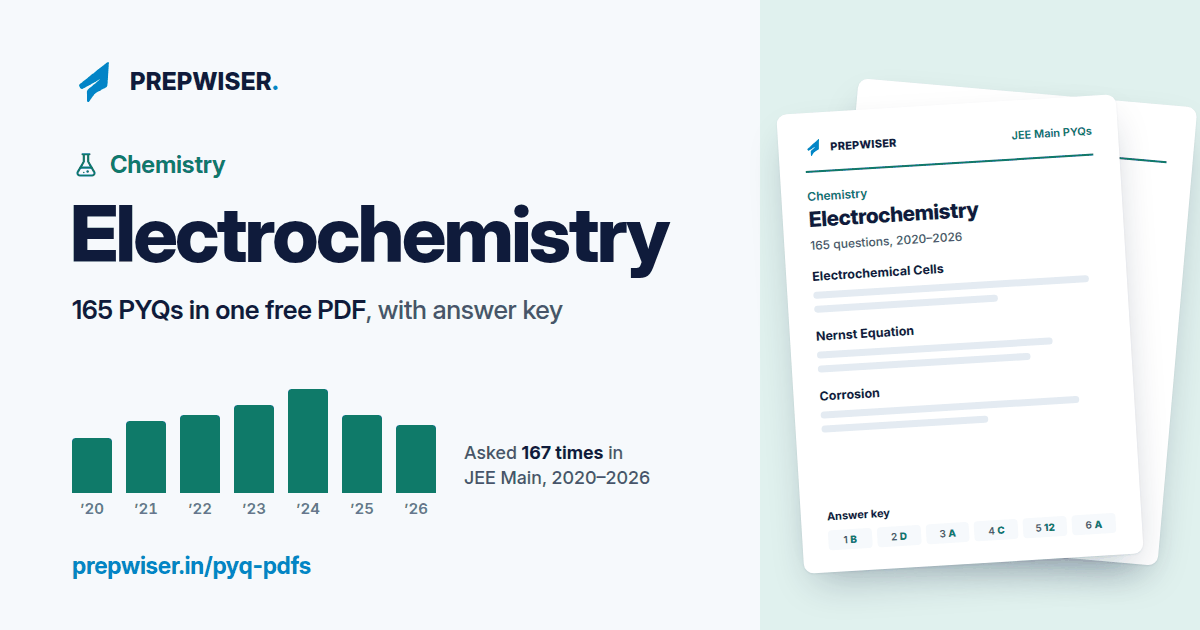
Electrochemistry has 167 questions in JEE Main papers from 2020 to 2026, about 24 per year across all shifts. The free PDF has 165 of them, each with its answer. The most asked topic is Nernst Equation (37 questions), followed by Conductance and Conductivity (29) and Electrolysis and Faraday's Laws (28).

Asked in JEE Main
1672020–2026, all shifts
In this free PDF
165with answers
Asked in 2026
21Latest paper: 2026 Apr S2
Most asked topic
Nernst Equation37 Qs · 22% of the chapter
Difficulty mix
30% easy · 66% medium · 4% hardof the questions in the PDF

Answer key includedNo loginPractise online

Source: official NTA JEE Main papers · Updated

Practise these 165 questions free, no login Download PDF (0.6 MB)

7 of this chapter's questions came back in a later paper (2021–2026). See the most repeated.

How often it's asked in JEE Main

Electrochemistry had about 1.3 questions per shift in recent JEE Main papers (2024–26). It's one of the most asked Chemistry chapters. Most asked topic in 2024–26: Electrochemical Cells. About 21 questions in the 2026 papers.

It came up in almost every 2024–26 shift in our bank (about 55 shifts). Question types in 2020–2026: about 74 MCQs and about 93 numerical.

How many questions from Electrochemistry in JEE Main, year by year

YearQuestionsPer shiftMCQNumerical
2026211.1912
2025241.3177
2024321.62012
2023271.1819
2022241.0816
2021220.8418
2020171.189
2020–20261671.17493

Most asked Electrochemistry topics, 2020–2026

TopicQuestions
Nernst Equation37
Conductance and Conductivity29
Electrolysis and Faraday's Laws28
Electrochemical Cells24
Standard Electrode Potential24

Every topic, year by year, is in the topic-wise table further down.

Counted from PrepWiser's question bank of JEE Main papers, 2020–2026. Per shift = questions that year ÷ shifts in our bank. Updated .

Download these numbers (CSV)

See all chapters' weightage →

Revise Electrochemistry before you practise

Two free sheets, made from the past JEE Main questions on this chapter.

Share card for Electrochemistry: JEE Main PYQs with answers, free PDF

Send this chapter to your study group

The link opens this page: the free PDF with 165 questions and answers, and online practice. Nobody needs to log in.

Electrochemistry questions per year

YearAskedIn PDF
20262121
20252424
20243232
20232727
20222423
20212222
20201716

in the free PDF asked, not in the PDFThe PDF only has questions we can print in full with a checked answer, so it holds 165 of the 167 asked.

Topic-wise weightage by year

How many Electrochemistry questions each topic had in every JEE Main year (all shifts), counting every question asked, including ones not in the PDF. Darker cells mean more questions.

TopicAskedShare2026202520242023202220212020
Nernst Equation3722%·449776
Conductance and Conductivity2917%2345573
Electrolysis and Faraday's Laws2817%1483534
Electrochemical Cells2415%14·43111
Standard Electrode Potential2414%·646422
Kohlrausch's Law138%333·121
Batteries and Fuel Cells106%13411··
Corrosion21%·11····
All topics167100%21243227242217

Swipe the table sideways for older years.

Newest questions (2026)

The 12 newest of the 21 JEE Main 2026 Electrochemistry questions in the free PDF, latest shift first.

  1. JEE Main 2026 · 8 Apr · Shift 2 · Electrochemical Cells

    Given at 298 K :

    EFe2+/Fe⊖=X VoltEFe3+/Fe⊖=Y Volt\begin{array}{cc} & {\mathrm{E}}_{{{\mathrm{Fe}}^{{2+}}/{\mathrm{Fe}}}}^{{\ominus}}={\mathrm{X}}\text{ Volt} \\ & {\mathrm{E}}_{{{\mathrm{Fe}}^{{3+}}/{\mathrm{Fe}}}}^{{\ominus}}={\mathrm{Y}}\text{ Volt}\end{array}

    The EFe3+/Fe2+⊖{\mathrm{E}}_{{{\mathrm{Fe}}^{{3+}}/{\mathrm{Fe}}^{{2+}}}}^{{\ominus}} in Volt at 298 K is given by :

    Solve it online →
  2. JEE Main 2026 · 6 Apr · Shift 1 · Kohlrausch's Law

    Consider the following data.\text{ Consider the following data.}

    Electrolyte∧m∘(S cm2 mol1)BaCl2x1H2SO4x2HClx3\begin{array}{cc}\text{ Electrolyte} & \wedge_{{\mathbf{m}}}^{{\circ}}{{(}}{\mathbf{S}\ \mathbf{c}\mathbf{m}}^{{{\mathbf{2}}}}{\ \mathbf{m}\mathbf{o}\mathbf{l}}^{{{\mathbf{1}}}}{)} \\ {\mathrm{BaCl}}_{2} & x_{1} \\ {\mathrm{H}}_{2}{\mathrm{SO}}_{4} & x_{2} \\ {\mathrm{HCl}} & x_{3}\end{array}

    BaSO4{\mathrm{BaSO}}_{4} is sparingly soluble in water. If the conductivity of the saturated BaSO4{\mathrm{BaSO}}_{4} solution is x S cm−1x{\ \mathrm{S}}{\ \mathrm{cm}}^{{-1}} then the solubility product of BaSO4{\mathrm{BaSO}}_{4} can be given as (Here ∧m=∧m∘\wedge_{{{\mathrm{m}}}}=\wedge_{{{\mathrm{m}}}}^{{\circ}} )

    Solve it online →
  3. JEE Main 2026 · 6 Apr · Shift 2 · Electrochemical Cells

    For a general redox reaction

    Anode   Red1→Ox1n1++n1e−\;\mathrm{Red}_{1}\rightarrow {\mathrm{Ox}}_{1}^{{{\mathrm{n}}_{1}^{{+}}}}+{\mathrm{n}}_{1}{\mathrm{e}}^{{-}}

    Cathode Ox2+n2e−→Red2n2−{\mathrm{O}}x_{2}+{\mathrm{n}}_{2}{\mathrm{e}}^{{-}}\rightarrow \mathrm{Red}_{2}^{{{\mathrm{n}}_{2}-}}

    Which of the following statement is incorrect?

    Solve it online →
  4. JEE Main 2026 · 5 Apr · Shift 2 · Electrochemical Cells

    One half cell in a voltaic cell is constructed by dipping silver rod in AgNO3{\mathrm{AgNO}}_{3} solution of unknown concentration, other half cell is Zn rod dipped in 1 molar solution of ZnSO4{\mathrm{ZnSO}}_{4}.

    A voltage of 1.60 V is measured at 298 K for this cell. What is the concentration of Ag+{\mathrm{Ag}}^{{+}}ions used in terms of log⁡x(x=[Ag+])\log x\left(x=\left[{\mathrm{Ag}}^{{+}}\right]\right)?

    EZn2+/Zn⊖=−0.76 V,  EAg+/Ag⊖=+0.80 V,2.303RT F=0.059 V{\mathrm{E}}_{{{\mathrm{Zn}}^{{2+}}/{\mathrm{Zn}}}}^{{\ominus}}=-0.76{\ \mathrm{V}},\;{\mathrm{E}}_{{{\mathrm{Ag}}^{{+}}/{\mathrm{Ag}}}}^{{\ominus}}=+0.80{\ \mathrm{V}},\frac{2.303{\mathrm{RT}}}{{\ \mathrm{F}}}=0.059{\ \mathrm{V}}

    Solve it online →
  5. JEE Main 2026 · 5 Apr · Shift 2 · Conductance and Conductivity

    At 298 K , the molar conductivity of x%(w/w)MXx\%({\mathrm{w}}/{\mathrm{w}}){\mathrm{MX}} solution (aqueous) is 123.5 S cm2 mol−1123.5{\ \mathrm{S}}{\ \mathrm{cm}}^{2}{\ \mathrm{mol}}^{{-1}}. The conductance of same solution is 1.9×10⁻³ S1.9\times {10}^{{-3}}{\ \mathrm{S}}. The value of xx is ____\_\_\_\_ ×10−2\times {10}^{{-2}}.

    (Given: cell constant =1.3 cm−1=1.3{\ \mathrm{cm}}^{{-1}}; molar mass of MX is 75 g mol−175{\ \mathrm{g}}{\ \mathrm{mol}}^{{-1}}, density of aqueous solution of MX at 298 K is 1.0 g mL−11.0{\ \mathrm{g}}{\ \mathrm{mL}}^{{-1}} )

    Solve it online →
  6. JEE Main 2026 · 4 Apr · Shift 2 · Electrochemical Cells

    An electrochemical cell, consist of the following two redox couples, Mx+(aq)/M(s)[EredΘ=+0.15 V]{\mathrm{M}}^{{x+}}({\mathrm{aq}})/{\mathrm{M}}({\mathrm{s}})\left[{\mathrm{E}}_{{\text{red}}}^{{\Theta}}=+0.15{\ \mathrm{V}}\right] and Fe3+(aq)/Fe(s)[EredΘ=−0.036 V]{\mathrm{Fe}}^{{3+}}({\mathrm{aq}})/{\mathrm{Fe}}({\mathrm{s}})\left[{\mathrm{E}}_{{\text{red}}}^{{\Theta}}=-0.036{\ \mathrm{V}}\right]. The cell EMF (Ecell)\left({\mathrm{E}}_{{\text{cell}}}\right) is recorded to be 0.2057 V . If the reaction quotient of the electrochemical reaction is found to be 10−2{10}^{{-2}}, then the value of xx is

    ____\_\_\_\_ .(Nearest integer)

    [Given : M is a p-block metal and 2.303RTF=0.059 V\frac{2.303RT}{F}=0.059{\ \mathrm{V}} ]

    Solve it online →
  7. JEE Main 2026 · 2 Apr · Shift 1 · Electrochemical Cells

    An electrochemical cell is constructed using half cells in the direction of spontaneous change:

    Fe(OH)2(s) + 2e− → Fe(s) + 2OH−(aq)      Eθ = −0.88 V

    and AgBr(s) + e− → Ag(s) + Br−(aq)      Eθ = +0.07 V

    Which of the following option is correct?

    Solve it online →
  8. JEE Main 2026 · 2 Apr · Shift 2 · Batteries and Fuel Cells

    Consider the following two half-cell reactions along with the standard reduction potential given :

    CO2+6H++6e−⟶CH3OH+H2O  Ered∘=0.02 V{\mathrm{CO}}_{2}+6{\mathrm{H}}^{+}+6e^{-}\longrightarrow {\mathrm{CH}}_{3}{\mathrm{OH}}+{\mathrm{H}}_{2}{\mathrm{O}}\;E_{{\text{red}}}^{{\circ}}=0.02\ {\mathrm{V}}

    12O2+2H++2e−⟶H2O  Ered∘=1.23 V\frac{1}{2}{\mathrm{O}}_{2}+2{\mathrm{H}}^{+}+2e^{-}\longrightarrow {\mathrm{H}}_{2}{\mathrm{O}}\;E_{{\text{red}}}^{{\circ}}=1.23\ {\mathrm{V}}

    A fuel cell was set up using the above two reactions such that the cell operates under the standard condition of 1 bar pressure and 298 K temperature. The fuel cell works with 80% efficiency. If the work derived from the cell using 1 mol of CH3OH{\mathrm{CH}}_{3}{\mathrm{OH}} is used to compress an ideal gas isothermally against a constant pressure of 1 kPa, then the change in the volume of the gas,

    ΔV=  ‾\Delta V=\underline{\;} m3{}^{3}. (nearest integer)

    Given : F=96500 C mol−1{\mathrm{F}}=96500\ {\mathrm{C}\ \mathrm{mol}}^{{-1}}

    Solve it online →
  9. JEE Main 2026 · 28 Jan · Shift 2 · Electrochemical Cells

    A volume of x mL of 5 M NaHCO3 solution was mixed with 10 mL of 2 M H2CO3 solution to make an electrolytic buffer. If the same buffer was used in the following electrochemical cell to record a cell potential of 235.3 mV, then the value of x = ______ mL (nearest integer).

    Sn(s) | Sn(OH)62− (0.5 M) | HSnO2− (0.05 M) | OH− | Bi2O3(s) | Bi(s)

    Consider up to one place of decimal for intermediate calculations


    [ Given:ESn(OH)62−∣HSnO2−o=−0.9VEoBi2O3∣Bi=−0.44 VpKa(H2CO3)=6.112.303RTF=0.059 V Antilog(1.29)=19.5]\left[\begin{array}{cc}\text{ Given:} & E_{{Sn{({OH})}_{6}^{{2-}}|HSnO_{2}^{-}}}^{o}=-0.9V \\ & {\mathrm{E}}^{{{\mathrm{o}}}}{}_{{{\mathrm{Bi}}_{2}{\mathrm{O}}_{3}\mid {\mathrm{Bi}}}}=-0.44{\ \mathrm{V}} \\ & {\mathrm{pKa}}_{{({\mathrm{H}}_{2}{\mathrm{CO}}_{3})}}=6.11 \\ & \frac{2.303{\mathrm{RT}}}{{\mathrm{F}}}=0.059{\ \mathrm{V}} \\ & \text{ Antilog}(1.29)=19.5\end{array}\right]
    Solve it online →
  10. JEE Main 2026 · 28 Jan · Shift 1 · Electrochemical Cells

    Consider the following redox reaction taking place in acidic medium

    BH4−(aq)+ClO3−(aq)⟶H2BO3−(aq)+Cl−(aq){\mathrm{BH}}_{4}^{{-}}(aq)+{\mathrm{ClO}}_{3}^{{-}}(aq)\longrightarrow {\mathrm{H}}_{2}{\mathrm{BO}}_{3}^{{-}}(aq)+{\mathrm{Cl}}^{{-}}(aq)

    If the Nernst equation for the above balanced reaction is

    Ecell=Ecell∘−RTnFln⁡Q,{\mathrm{E}}_{{{\mathrm{cell}}}}={\mathrm{E}}_{{{\mathrm{cell}}}}^{{\circ}}-\frac{{\mathrm{RT}}}{{\mathrm{nF}}}\ln {\mathrm{Q}},

    then the value of nn is ____\_\_\_\_ .(Nearest integer)

    Solve it online →
  11. JEE Main 2026 · 28 Jan · Shift 2 · Kohlrausch's Law

    For strong electrolyte Λm\Lambda_{m} increases slowly with dilution and can be represented by the equation

    Λm=Λm∘−Ac1/2\Lambda_{m}=\Lambda_{m}^{\circ}-Ac^{{1/2}}

    Molar conductivity values of the solutions of strong electrolyte AB at 18°C are given below :

    c [mol L-1]0.040.090.160.25
    Λm\Lambda_{m} [S cm2 mol-1]96.195.795.394.9

    The value of constant A based on the above data [in S cm2 mol-1/(mol/L)1/2] unit is ________.

    Solve it online →
  12. JEE Main 2026 · 24 Jan · Shift 1 · Electrolysis and Faraday's Laws

    Electricity is passed through an acidic solution of Cu2+{\mathrm{Cu}}^{{2+}} till all the Cu2+{\mathrm{Cu}}^{{2+}} was exhausted, leading to the deposition of 300 mg of Cu metal. However, a current of 600 mA was continued to pass through the same solution for another 28 minutes by keeping the total volume of the solution fixed at 200 mL . The total volume of oxygen evolved at STP during the entire process is ____\_\_\_\_ mL . (Nearest integer)

    [Given:

    Cu2+(aq)+2e−→Cu( s)Eredo=+0.34 VO2( g)+4H++4e−→2H2OEredo=+1.23 V\begin{array}{cc} & {\mathrm{Cu}}^{{2+}}({\mathrm{aq}})+2{\mathrm{e}}^{{-}}\rightarrow {\mathrm{Cu}}({\ \mathrm{s}}){\mathrm{E}}_{{{\mathrm{red}}}}^{{{\mathrm{o}}}}=+0.34{\ \mathrm{V}} \\ & {\mathrm{O}}_{2}({\ \mathrm{g}})+4{\mathrm{H}}^{{+}}+4{\mathrm{e}}^{{-}}\rightarrow 2{\mathrm{H}}_{2}{\mathrm{O}}{\mathrm{E}}_{{{\mathrm{red}}}}^{{{\mathrm{o}}}}=+1.23{\ \mathrm{V}}\end{array}

    Molar mass of Cu=63.54 g mol−1{\mathrm{Cu}}=63.54{\ \mathrm{g}}{\ \mathrm{mol}}^{{-1}}

    Molar mass of O2=32 g mol−1{\mathrm{O}}_{2}=32{\ \mathrm{g}}{\ \mathrm{mol}}^{{-1}}

    Faraday Constant =96500Cmol−1=96500{\mathrm{C}}{\mathrm{mol}}^{{-1}}

    Molar volume at STP=22.4 L{\mathrm{STP}}=22.4{\ \mathrm{L}} ]

    Solve it online →

Practise the 2026 Electrochemistry questions online

Sample questions from recent papers

JEE Main 2026 · 24 Jan · Shift 2 · Kohlrausch's Law

Molar conductivity of a weak acid HQ of concentration 0.18 M was found to be 1/301/30 of the molar conductivity of another weak acid HZ with concentration of 0.02 M . If λ∘Q−\lambda^{{\circ}}{\mathrm{Q}}^{{-}}happened to be equal with λ∘Z−\lambda^{{\circ}}{\mathrm{Z}}^{{-}}, then the difference of the pKa{\mathrm{pK}}_{{{\mathrm{a}}}} values of the two weak acids (pKa(HQ)−pKa(HZ))({\mathrm{pK}}_{{{\mathrm{a}}}}({\mathrm{HQ}})-{\mathrm{pK}}_{{{\mathrm{a}}}}({\mathrm{HZ}})) is ____\_\_\_\_ (Nearest integer).

[Given: degree of dissociation (α)≪1(\alpha)\ll 1 for both weak acids, λ∘\lambda^{{\circ}} : limiting molar conductivity of ions]

Show answerHide answer

Answer: 2

Solve online

JEE Main 2026 · 21 Jan · Shift 1 · Conductance and Conductivity

The pH and conductance of a weak acid (HX)({\mathrm{HX}}) was found to be 5 and 4×10⁻⁵ S4\times {10}^{{-5}}{\ \mathrm{S}}, respectively. The conductance was measured under standard condition using a cell where the electrode plates having a surface area of 1 cm21{\ \mathrm{cm}}^{2} were at a distance of 15 cm apart. The value of the limiting molar conductivity is ____\_\_\_\_ Sm2 mol−1{\mathrm{S}}{\mathrm{m}}^{2}{\ \mathrm{mol}}^{{-1}}. (nearest integer)

(Given : degree of dissociation of the weak acid (α)≪1(\alpha)\ll 1 )

Show answerHide answer

Answer: 6

Solve online

JEE Main 2025 · 8 Apr · Shift 2 · Nernst Equation

Consider the following half cell reaction

Cr2O72− (aq)+6e−+14H+ (aq)→2Cr3+ (aq)+7H2O (ℓ)\text{Cr}_2\text{O}_7^{2-} \, (\text{aq}) + 6\text{e}^- + 14\text{H}^+ \, (\text{aq}) \rightarrow 2\text{Cr}^{3+} \, (\text{aq}) + 7\text{H}_2\text{O} \, (\ell)

The reaction was conducted with the ratio of [Cr3+]2[Cr2O72−]=10−6\frac{[\text{Cr}^{3+}]^2}{[\text{Cr}_2\text{O}_7^{2-}]} = 10^{-6}. The pH value at which the EMF of the half cell will become zero is __________.

(nearest integer value)

[Given: standard half cell reduction potential ECr2O72−,H+/Cr3+∘=1.33 VE^{\circ}_{\text{Cr}_2\text{O}_7^{2-}, \text{H}^+/\text{Cr}^{3+}} = 1.33\, \text{V}, 2.303RTF=0.059 V\frac{2.303RT}{F} = 0.059\, \text{V}.]

Show answerHide answer

Answer: 10

Solve online

JEE Main 2025 · 7 Apr · Shift 2 · Standard Electrode Potential

Given below are two statements :

1 M aqueous solutions of each of Cu(NO3)2, AgNO3, Hg2(NO3)2, Mg(NO3)2 are electrolysed using inert electrodes. Given: E0Ag+/Ag = 0.80 V, E0Hg22+/Hg = 0.79 V, E0Cu2+/Cu = 0.24 V and E0Mg2+/Mg = -2.37 V.

Statement (I) : With increasing voltage, the sequence of deposition of metals on the cathode will be Ag, Hg and Cu.

Statement (II) : Magnesium will not be deposited at the cathode instead oxygen gas will be evolved at the cathode.

In the light of the above statements, choose the most appropriate answer from the options given below :

  1. (A)

    Both Statement I and Statement II are incorrect

  2. (B)

    Statement I is incorrect but Statement II is correct

  3. (C)

    Statement I is correct but Statement II is incorrect

  4. (D)

    Both Statement I and Statement II are correct

Show answerHide answer

Answer: (C)

Solve online

JEE Main 2025 · 4 Apr · Shift 1 · Batteries and Fuel Cells

On charging the lead storage battery, the oxidation state of lead changes from x1x_1 to y1y_1 at the anode and from x2x_2 to y2y_2 at the cathode. The values of x1,y1,x2,y2x_1, y_1, x_2, y_2 are respectively :

  1. (A) 0,+2,+4,+20,+2,+4,+2
  2. (B) +2,0,0,+4+2,0,0,+4
  3. (C) +4,+2,0,+2+4,+2,0,+2
  4. (D) +2,0,+2,+4+2,0,+2,+4
Show answerHide answer

Answer: (D)

Solve online

JEE Main 2025 · 29 Jan · Shift 2 · Electrolysis and Faraday's Laws

O2\mathrm{O}_2 gas will be evolved as a product of electrolysis of :

(A) an aqueous solution of AgNO3\mathrm{AgNO}_3 using silver electrodes.

(B) an aqueous solution of AgNO3\mathrm{AgNO}_3 using platinum electrodes.

(C) a dilute solution of H2SO4\mathrm{H}_2 \mathrm{SO}_4 using platinum electrodes.

(D) a high concentration solution of H2SO4\mathrm{H}_2 \mathrm{SO}_4 using platinum electrodes.

Choose the correct answer from the options given below :

  1. (A)(B) and (C) only
  2. (B)(B) and (D) only
  3. (C) (A) and (D) only
  4. (D)(A)(A) and (C)(C) only
Show answerHide answer

Answer: (A)

Solve online

The free PDF above has all 165 questions grouped by topic, with an answer key.

Practise these online, free, no login

Answer Electrochemistry PYQs in the browser, get each one checked instantly and open the step-by-step solution where there is one.

Practise Electrochemistry online

Frequently asked

How many questions come from Electrochemistry in JEE Main?

167 questions from 2020 to 2026, about 24 per year. In 2026 it had 21. The free PDF has 165 of them.

Which Electrochemistry topics are most important for JEE Main?

By past papers: Nernst Equation (22%), Conductance and Conductivity (17%) and Electrolysis and Faraday's Laws (17%) of all Electrochemistry questions.

Is the Electrochemistry PYQ PDF free?

Yes. The PDF and its answer key are free, and you can practise the questions online with no login, with step-by-step solutions where available.

More Chemistry chapters

JEE Main PYQs by year: 2026 · 2025 · 2024 · 2023 · 2022 · 2021 · 2020

Answers follow NTA's final answer keys. Typing errors are possible, so check doubtful answers against the official key. Spotted a mistake? prepwiser.in/feedback · Terms: prepwiser.in/terms