p-Block Elements: Part II (Group 15-18) JEE Main PYQs PDF, 2020–2026
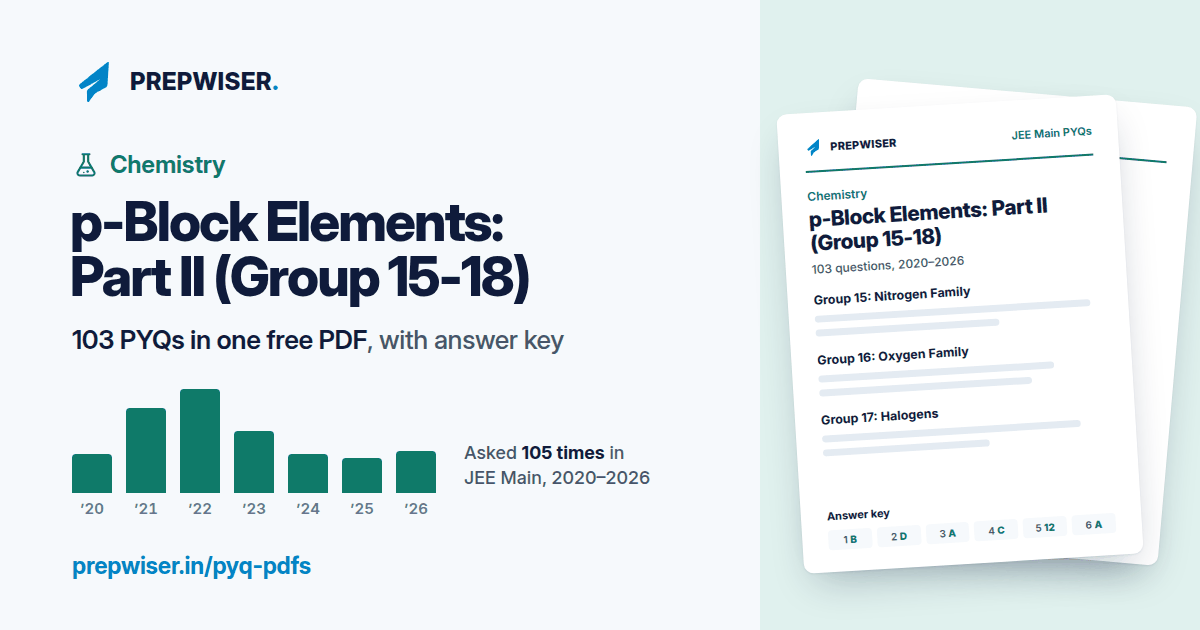
p-Block Elements: Part II (Group 15-18) has 105 questions in JEE Main papers from 2020 to 2026, about 15 per year across all shifts. The free PDF has 103 of them, each with its answer. The most asked topic is Group 15: Nitrogen Family (60 questions), followed by Group 16: Oxygen Family (20) and Group 17: Halogens (20).
Asked in JEE Main
1052020–2026, all shifts
In this free PDF
103with answers
Asked in 2026
11Latest paper: 2026 Apr S2
Most asked topic
Group 15: Nitrogen Family60 Qs · 57% of the chapter
1 of this chapter's questions came back in a later paper (2021–2026). See the most repeated.
How often it's asked in JEE Main
p-Block Elements: Part II (Group 15-18) had about 0.5 questions per shift in recent JEE Main papers (2024–26). Its share has fallen since 2020–22. Most asked topic: Group 15: Nitrogen Family. About 11 questions in the 2026 papers. (Some topics were cut in 2024; see what changed.)
It came up in about 26 of the 2024–26 shifts in our bank. Question types in 2020–2026: about 90 MCQs and about 15 numerical.
How many questions from p-Block Elements: Part II (Group 15-18) in JEE Main, year by year
Year
Questions
Per shift
MCQ
Numerical
2026
11
0.6
11
0
2025
9
0.5
8
1
2024
10
0.5
9
1
2023
16
0.7
12
4
2022
27
1.2
24
3
2021
22
0.8
17
5
2020
10
0.6
9
1
2020–2026
105
0.7
90
15
Most asked p-Block Elements: Part II (Group 15-18) topics, 2020–2026
Topic
Questions
Group 15: Nitrogen Family
60
Group 16: Oxygen Family
20
Group 17: Halogens
20
Group 18: Noble Gases
5
Counted from PrepWiser's question bank of JEE Main papers, 2020–2026. Per shift = questions that year ÷ shifts in our bank. Updated .
p-Block Elements: Part II (Group 15-18) questions per year
Year
Asked
In PDF
2026
11
11
2025
9
8
2024
10
10
2023
16
16
2022
27
27
2021
22
21
2020
10
10
in the free PDF asked, not in the PDFThe PDF only has questions we can print in full with a checked answer, so it holds 103 of the 105 asked.
Topic-wise weightage by year
How many p-Block Elements: Part II (Group 15-18) questions each topic had in every JEE Main year (all shifts), counting every question asked, including ones not in the PDF. Darker cells mean more questions.
Topic
Asked
Share
2026
2025
2024
2023
2022
2021
2020
Group 15: Nitrogen Family
60
57%
8
5
2
8
21
10
6
Group 16: Oxygen Family
20
19%
1
3
5
1
3
6
1
Group 17: Halogens
20
19%
2
1
2
4
3
5
3
Group 18: Noble Gases
5
5%
·
·
1
3
·
1
·
All topics
105
100%
11
9
10
16
27
22
10
Swipe the table sideways for older years.
Newest questions (2026)
All 11 JEE Main 2026 p-Block Elements: Part II (Group 15-18) questions in the free PDF, latest shift first.
JEE Main 2026 · 8 Apr · Shift 2 · Group 15: Nitrogen Family
Find the correct statements related to group 15 hydrides.
A. Reducing nature increases from NH3 to BiH3
B. Tendency to donate lone pair of electrons decreases from NH3 to BiH3
C. The stability of hydrides decreases from NH3 to BiH3
D. HEH bond angle decreases from NH3 to SbH3(E= Elements of group 15)
Choose the correct answer from the options given below :
JEE Main 2026 · 4 Apr · Shift 1 · Group 15: Nitrogen Family
A monoatomic anion (A ) has 45 neutrons and 36 electrons. Atomic mass, group in the periodic table and physical state at room temperature of the element (A) respectively are
JEE Main 2026 · 22 Jan · Shift 1 · Group 15: Nitrogen Family
A 'p'-block element (E) and hydrogen form a binary cation (EHx)+, while EH3 on treatment with K2HgI4 in alkaline medium gives a precipitate of basic mercury(II)amido-iodine. Given below are first ionisation enthalpy values (kJmol−1) for first element each from group 13, 14, 15 and 16. Identify the correct first ionisation enthalpy value for element E.
JEE Main 2026 · 22 Jan · Shift 1 · Group 17: Halogens
Given below are two statements :
Statement I : The halogen that makes longest bond with hydrogen in HX, has the smallest covalent radius in its group.
Statement II : A group 15 element's hydride EH3 has the lowest boiling point among corresponding hydrides of other group 15 elements. The maximum covalency of that element E is 4 .
In the light of the above statements, choose the correct answer from the options given below
JEE Main 2026 · 22 Jan · Shift 2 · Group 15: Nitrogen Family
Given below are two statements :
Statement I : Elements ' X ' and ' Y ' are the most and least electronegative elements, respectively among N,As,Sb and P . The nature of the oxides X2O3 and Y2O3 is acidic and amphoteric, respectively.
Statement II :BCl3 is covalent in nature and gets hydrolysed in water. It produces [B(OH)4]− and [B(H2O)6]3+ in aqueous medium.
In the light of the above statements, choose the correct answer from the options given below :
JEE Main 2024 · 31 Jan · Shift 1 · Group 18: Noble Gases
Give below are two statements:
Statement - I: Noble gases have very high boiling points.
Statement - II: Noble gases are monoatomic gases. They are held together by strong dispersion forces. Because of this they are liquefied at very low temperature. Hence, they have very high boiling points.
In the light of the above statements, choose the correct answer from the options given below:
The free PDF above has all 103 questions grouped by topic, with an answer key.
Practise these online, free, no login
Answer p-Block Elements: Part II (Group 15-18) PYQs in the browser, get each one checked instantly and open the step-by-step solution where there is one.
How many questions come from p-Block Elements: Part II (Group 15-18) in JEE Main?
105 questions from 2020 to 2026, about 15 per year. In 2026 it had 11. The free PDF has 103 of them.
Which p-Block Elements: Part II (Group 15-18) topics are most important for JEE Main?
By past papers: Group 15: Nitrogen Family (57%), Group 16: Oxygen Family (19%) and Group 17: Halogens (19%) of all p-Block Elements: Part II (Group 15-18) questions.
Is the p-Block Elements: Part II (Group 15-18) PYQ PDF free?
Yes. The PDF and its answer key are free, and you can practise the questions online with no login, with step-by-step solutions where available.
Answers follow NTA's final answer keys. Typing errors are possible, so check doubtful answers against the official key. Spotted a mistake? prepwiser.in/feedback · Terms: prepwiser.in/terms