PREPWISER.

Chemical Bonding & Molecular Structure JEE Main PYQs PDF, 2020–2026

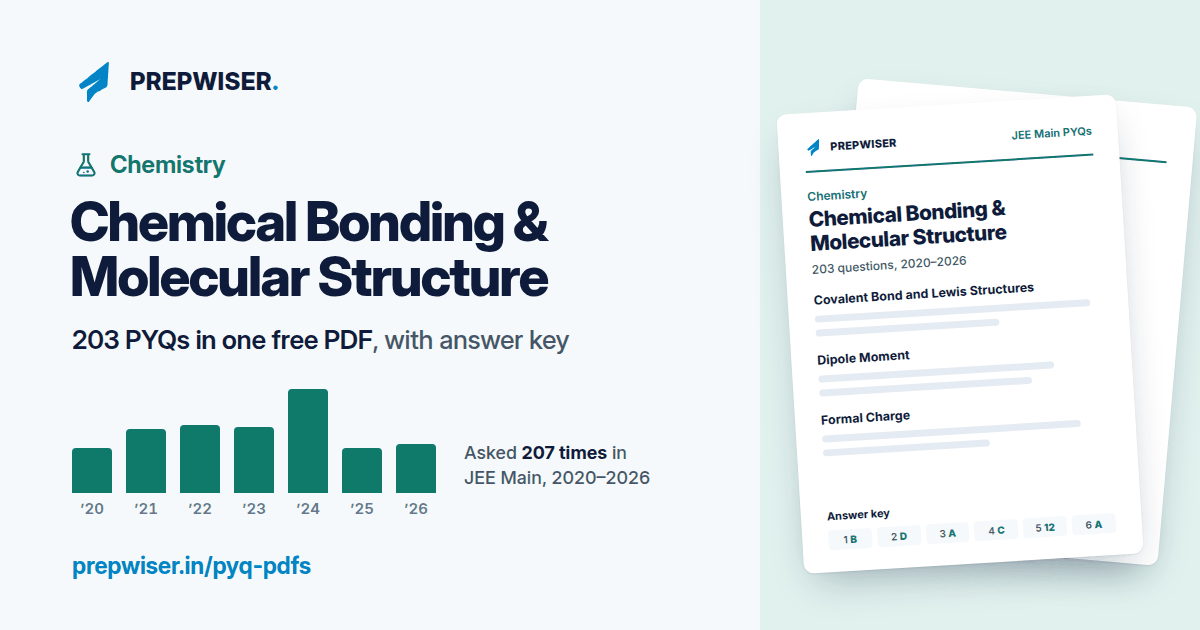
Chemical Bonding & Molecular Structure has 207 questions in JEE Main papers from 2020 to 2026, about 30 per year across all shifts. The free PDF has 203 of them, each with its answer. The most asked topic is VSEPR Theory (64 questions), followed by Molecular Orbital Theory (46) and Hybridisation (25).

Asked in JEE Main
2072020–2026, all shifts
In this free PDF
203with answers
Asked in 2026
23Latest paper: 2026 Apr S2
Most asked topic
VSEPR Theory64 Qs · 31% of the chapter
Difficulty mix
51% easy · 49% mediumof the questions in the PDF

Answer key includedNo loginPractise online

Source: official NTA JEE Main papers · Updated

Practise these 203 questions free, no login Download PDF (0.7 MB)

3 of this chapter's questions came back in a later paper (2021–2026). See the most repeated.

How often it's asked in JEE Main

Chemical Bonding & Molecular Structure had about 1.6 questions per shift in recent JEE Main papers (2024–26). It's one of the most asked Chemistry chapters. Most asked topic: VSEPR Theory. About 23 questions in the 2026 papers.

It came up in almost every 2024–26 shift in our bank (about 54 shifts). Question types in 2020–2026: about 138 MCQs and about 69 numerical.

How many questions from Chemical Bonding & Molecular Structure in JEE Main, year by year

YearQuestionsPer shiftMCQNumerical
2026231.2212
2025211.1174
2024492.52722
2023311.31714
2022321.41913
2021301.21812
2020211.3192
2020–20262071.413869

Most asked Chemical Bonding & Molecular Structure topics, 2020–2026

TopicQuestions
VSEPR Theory64
Molecular Orbital Theory46
Hybridisation25
Covalent Bond and Lewis Structures24
Dipole Moment20

Every topic, year by year, is in the topic-wise table further down.

Counted from PrepWiser's question bank of JEE Main papers, 2020–2026. Per shift = questions that year ÷ shifts in our bank. Updated .

Download these numbers (CSV)

See all chapters' weightage →

Revise Chemical Bonding & Molecular Structure before you practise

Two free sheets, made from the past JEE Main questions on this chapter.

Share card for Chemical Bonding & Molecular Structure: JEE Main PYQs with answers, free PDF

Send this chapter to your study group

The link opens this page: the free PDF with 203 questions and answers, and online practice. Nobody needs to log in.

Chemical Bonding & Molecular Structure questions per year

YearAskedIn PDF
20262323
20252121
20244948
20233129
20223231
20213030
20202121

in the free PDF asked, not in the PDFThe PDF only has questions we can print in full with a checked answer, so it holds 203 of the 207 asked.

Topic-wise weightage by year

How many Chemical Bonding & Molecular Structure questions each topic had in every JEE Main year (all shifts), counting every question asked, including ones not in the PDF. Darker cells mean more questions.

TopicAskedShare2026202520242023202220212020
VSEPR Theory6431%126101110105
Molecular Orbital Theory4622%54115993
Hybridisation2512%·37·645
Covalent Bond and Lewis Structures2412%3446223
Dipole Moment2010%22932·2
Hydrogen Bonding189%·164142
Ionic Bond94%·122211
Formal Charge10%1······
All topics207100%23214931323021

Swipe the table sideways for older years.

Newest questions (2026)

The 12 newest of the 23 JEE Main 2026 Chemical Bonding & Molecular Structure questions in the free PDF, latest shift first.

  1. JEE Main 2026 · 8 Apr · Shift 2 · VSEPR Theory

    Bromine trifluoride autoionizes to form BrF2⊕{\mathrm{BrF}}_{2}^{{\oplus}} and BrF4⊖{\mathrm{BrF}}_{4}^{{\ominus}}. The shapes of the cation and anion are respectively ____\_\_\_\_ and ____\_\_\_\_ .

    Solve it online →
  2. JEE Main 2026 · 6 Apr · Shift 2 · VSEPR Theory

    Given below are two statements :

    Statement I : F2O<H2O<Cl2O{\mathrm{F}}_{2}{\mathrm{O}}<{\mathrm{H}}_{2}{\mathrm{O}}<{\mathrm{Cl}}_{2}{\mathrm{O}} is the correct trend in terms of bond angle.

    Statement II : SiF4,SnF4{\mathrm{SiF}}_{4},{\mathrm{SnF}}_{4} and PbF4{\mathrm{PbF}}_{4} are ionic in nature.

    In the light of the above statements, choose the correct answer from the options given below :

    Solve it online →
  3. JEE Main 2026 · 6 Apr · Shift 1 · Covalent Bond and Lewis Structures

    The pairs among

    A=[SO32−,CO32−],B=[O22−,F2],C=[CN−,CO],D=[NH3,H3O+]{\mathrm{A}}=\left[{\mathrm{SO}}_{3}^{{2-}},{\mathrm{CO}}_{3}^{{2-}}\right],{\mathrm{B}}=\left[{\mathrm{O}}_{2}^{{2-}},{\mathrm{F}}_{2}\right],{\mathrm{C}}=\left[{\mathrm{CN}}^{{-}},{\mathrm{CO}}\right],{\mathrm{D}}=[{\mathrm{NH}}_{3},{\mathrm{H}}_{3}{\mathrm{O}}^{{+}}]and E=[MnO42−,CrO42−]{\mathrm{E}}=\left[{\mathrm{MnO}}_{4}^{{2-}},{\mathrm{CrO}}_{4}^{{2-}}\right] that do not have similar Lewis dot structure are

    Solve it online →
  4. JEE Main 2026 · 6 Apr · Shift 2 · VSEPR Theory

    Given below are two statements :

    Statement I : The number of compounds among SO2,SO3,SF4,SF6{\mathrm{SO}}_{2},{\mathrm{SO}}_{3},{\mathrm{SF}}_{4},{\mathrm{SF}}_{6} and H2 S{\mathrm{H}}_{2}{\ \mathrm{S}} in which sulphur does not obey the Octet rule is 3 .

    Statement II : Among [H2O,ClF3,SF4],[NH3,BrF5,SF4],[BrF5,ClF3,XeF4][{\mathrm{H}}_{2}{\mathrm{O}},{\mathrm{ClF}}_{3},{\mathrm{SF}}_{4}],[{\mathrm{NH}}_{3},{\mathrm{BrF}}_{5},{\mathrm{SF}}_{4}],[{\mathrm{BrF}}_{5},{\mathrm{ClF}}_{3},{\mathrm{XeF}}_{4}] and [ XeF4,ClF3,H2O{\mathrm{XeF}}_{4},{\mathrm{ClF}}_{3},{\mathrm{H}}_{2}{\mathrm{O}} ], the number of sets in which all the molecules have one lone pair of electrons on the central atom is 1 .

    In the light of the above statements, choose the correct answer from the options given below :

    Solve it online →
  5. JEE Main 2026 · 5 Apr · Shift 1 · VSEPR Theory

    Consider the following species:

    BrF5,XeF5−,BF4−,ICl4−,XeF4,SF4,NH4+,ClF3,XeF2,ICl2−{\mathrm{BrF}}_{5},{\mathrm{XeF}}_{5}^{{-}},{\mathrm{BF}}_{4}^{{-}},{\mathrm{ICl}}_{4}^{{-}},{\mathrm{XeF}}_{4},{\mathrm{SF}}_{4},{\mathrm{NH}}_{4}^{{+}},{\mathrm{ClF}}_{3},{\mathrm{XeF}}_{2},{\mathrm{ICl}}_{2}^{{-}}

    Number of species having sp3 d{\mathrm{sp}}^{3}{\ \mathrm{d}} hybridized central atom is ____\_\_\_\_ .

    Solve it online →
  6. JEE Main 2026 · 5 Apr · Shift 2 · Molecular Orbital Theory

    The covalent radii of atoms AA and BB are rAr_{A} and rBr_{B}, respectively. The covalent bond length and total length of AB molecule are respectively

    Solve it online →
  7. JEE Main 2026 · 4 Apr · Shift 2 · Molecular Orbital Theory

    Which of the following pictorial diagram most correctly represents the π∗\pi^{\ast} ( π\pi antibonding) molecular orbital between two atoms if the internuclear axis is taken to be in the zz-direction (→z-axis  )({{}\xrightarrow{z\text{-axis}\;}}) ?

    Solve it online →
  8. JEE Main 2026 · 4 Apr · Shift 1 · Covalent Bond and Lewis Structures

    According to Lewis theory, the total number of σ\sigma bond-pairs and lone pair of electrons around the central atom of XeO64−{\mathrm{XeO}}_{6}{}^{{4-}} ion is ____\_\_\_\_ .

    Solve it online →
  9. JEE Main 2026 · 2 Apr · Shift 2 · VSEPR Theory

    SF4{}_{4} is isostructural with :

    A. BrF4⊖{}_{4}^{\ominus}

    B. CH4{}_{4}

    C. IF4⊕{}_{4}^{{\oplus}}

    D. XeF4{}_{4}

    E. XeO2{}_{2}F2{}_{2}

    Choose the correct answer from the options given below :

    Solve it online →
  10. JEE Main 2026 · 2 Apr · Shift 1 · Molecular Orbital Theory

    Given below are two statements :

    Statement (I): The correct sequence of bond lengths in the following species is :

    O2+<O2<O2−<O22−{{\mathrm{O}}{{\phantom{}}}_{{{2}}}{{\phantom{}}}^{{+}}}<{{\mathrm{O}}{{\phantom{}}}_{{{2}}}}<{{\mathrm{O}}{{\phantom{}}}_{{{2}}}{{\phantom{}}}^{{-}}}<{{\mathrm{O}}{{\phantom{}}}_{{{2}}}{{\phantom{}}}^{{2-}}}

    Statement (II): The correct sequence of number of unpaired electrons in the following species is :

    O2>O2+>O2−>O22−{{\mathrm{O}}{{\phantom{}}}_{{{2}}}}>{{\mathrm{O}}{{\phantom{}}}_{{{2}}}{{\phantom{}}}^{{+}}}>{{\mathrm{O}}{{\phantom{}}}_{{{2}}}{{\phantom{}}}^{{-}}}>{{\mathrm{O}}{{\phantom{}}}_{{{2}}}{{\phantom{}}}^{{2-}}}

    In the light of the above statements, choose the correct answer from the options given below :

    Solve it online →
  11. JEE Main 2026 · 28 Jan · Shift 1 · VSEPR Theory

    Given below are two statements :

    Statement I : The number of species among BF4−,SiF4,XeF4{\mathrm{BF}}_{4}^{{-}},{\mathrm{SiF}}_{4},{\mathrm{XeF}}_{4} and SF4{\mathrm{SF}}_{4}, that have unequal E−F{\mathrm{E}}-{\mathrm{F}} bond lengths is two. Here, E is the central atom.

    Statement II : Among O2−,O22−,F2{\mathrm{O}}_{2}^{{-}},{\mathrm{O}}_{2}^{{2-}},{\mathrm{F}}_{2} and O2+,O2−{\mathrm{O}}_{2}^{{+}},{\mathrm{O}}_{2}^{{-}}has the highest bond order.

    In the light of the above statements, choose the correct answer from the options given below

    Solve it online →
  12. JEE Main 2026 · 28 Jan · Shift 2 · VSEPR Theory

    Match List - I with List - II according to shape.

    List – I List – II
    A.  XeO3

    B.  XeF2

    C.  XeO2F2

    D.  XeOF4
    I.  BrF5

    II.  NH3

    III.  [I3]−

    IV.  SF4

    Choose the correct answer from the options given below :

    Solve it online →

Practise the 2026 Chemical Bonding & Molecular Structure questions online

Sample questions from recent papers

JEE Main 2026 · 24 Jan · Shift 1 · Dipole Moment

Given below are statements about some molecules/ions.

Identify the CORRECT statements.

A. The dipole moment value of NF3{\mathrm{NF}}_{3} is higher than that of NH3{\mathrm{NH}}_{3}.

B. The dipole moment value of BeH2{\mathrm{BeH}}_{2} is zero.

C. The bond order of O22−{\mathrm{O}}_{2}{}^{{2-}} and F2{\mathrm{F}}_{2} is same.

D. The formal charge on the central oxygen atom of ozone is -1 .

E. In NO2{\mathrm{NO}}_{2}, all the three atoms satisfy the octet rule, hence it is very stable.

Choose the correct answer from the options given below:

  1. (A)

    B & C Only

  2. (B)

    B, C & D Only

  3. (C)

    A, C & D Only

  4. (D)

    A, B, C, D & E

Show answerHide answer

Answer: (A)

Solve online

JEE Main 2026 · 22 Jan · Shift 1 · Formal Charge

The formal charges on the atoms marked as (1) to (4) in the Lewis representation of HNO3{\mathrm{HNO}}_{3} molecule respectively are

JEE Main PYQ figure

  1. (A)

    0,0,−1,+10,0,-1,+1

  2. (B)

    0,−1,0,+10,-1,0,+1

  3. (C)

    0,+1,0,−10,+1,0,-1

  4. (D)

    +1,0,0,−1+1,0,0,-1

Show answerHide answer

Answer: (C)

Solve online

JEE Main 2026 · 21 Jan · Shift 2 · Covalent Bond and Lewis Structures

The correct increasing order of C–H(A), C–O(B), C=O(C) and C≡N(D) bonds in terms of covalent bond length is :

  1. (A)

    D < C < B < A

  2. (B)

    D < C < A < B

  3. (C)

    A < B < C < D

  4. (D)

    A < D < C < B

Show answerHide answer

Answer: (D)

Solve online

JEE Main 2025 · 7 Apr · Shift 2 · Hybridisation

In SO2, NO2−- and N3−-, the hybridizations at the central atom are respectively :

  1. (A)

    sp2, sp2 and sp2

  2. (B)

    sp, sp2 and sp

  3. (C)

    sp2, sp and sp

  4. (D)

    sp2, sp2 and sp

Show answerHide answer

Answer: (D)

Solve online

JEE Main 2025 · 29 Jan · Shift 1 · Ionic Bond

An element ‘E’ has the ionisation enthalpy value of 374 kJ mol⁻¹. ‘E’ reacts with elements A, B, C and D with electron gain enthalpy values of −328, −349, −325 and −295 kJ mol⁻¹, respectively. The correct order of the products EA, EB, EC and ED in terms of ionic character is :

  1. (A)

    EB > EA > EC > ED

  2. (B)

    EA > EB > EC > ED

  3. (C)

    ED > EC > EA > EB

  4. (D)

    ED > EC > EB > EA

Show answerHide answer

Answer: (A)

Solve online

JEE Main 2025 · 23 Jan · Shift 2 · Hydrogen Bonding

Given below are two statements :

Statement (I) : The boiling points of alcohols and phenols increase with increase in the number of C -atoms.

Statement (II) : The boiling points of alcohols and phenols are higher in comparison to other class of compounds such as ethers, haloalkanes.

In the light of the above statements, choose the correct answer from the options given below :

  1. (A)Statement I is false but Statement II is true
  2. (B)Both Statement I and Statement II are true
  3. (C)Statement I is true but Statement II is false
  4. (D)Both Statement I and Statement II are false
Show answerHide answer

Answer: (B)

Solve online

The free PDF above has all 203 questions grouped by topic, with an answer key.

Practise these online, free, no login

Answer Chemical Bonding & Molecular Structure PYQs in the browser, get each one checked instantly and open the step-by-step solution where there is one.

Practise Chemical Bonding & Molecular Structure online

Frequently asked

How many questions come from Chemical Bonding & Molecular Structure in JEE Main?

207 questions from 2020 to 2026, about 30 per year. In 2026 it had 23. The free PDF has 203 of them.

Which Chemical Bonding & Molecular Structure topics are most important for JEE Main?

By past papers: VSEPR Theory (31%), Molecular Orbital Theory (22%) and Hybridisation (12%) of all Chemical Bonding & Molecular Structure questions.

Is the Chemical Bonding & Molecular Structure PYQ PDF free?

Yes. The PDF and its answer key are free, and you can practise the questions online with no login, with step-by-step solutions where available.

More Chemistry chapters

JEE Main PYQs by year: 2026 · 2025 · 2024 · 2023 · 2022 · 2021 · 2020

Answers follow NTA's final answer keys. Typing errors are possible, so check doubtful answers against the official key. Spotted a mistake? prepwiser.in/feedback · Terms: prepwiser.in/terms