JEE Main 2026 · 2 Apr · Shift 1 · IUPAC Nomenclature
In IUPAC nomenclature, the correct order of decreasing priority of functional group is :
- (A)

- (B)
- (C)

- (D)
Show answerHide answer
Answer: (C)
General Organic Chemistry (GOC) has 176 questions in JEE Main papers from 2020 to 2026, about 25 per year across all shifts. The free PDF has 156 of them, each with its answer. The most asked topic is IUPAC Nomenclature (41 questions), followed by Stereoisomerism (34) and Electronic Effects (32).
Answer key includedNo loginPractise online
Source: official NTA JEE Main papers · Updated
Your PDF is downloading. Practise these questions online, free, no login →
1 of this chapter's questions came back in a later paper (2021–2026). See the most repeated.
General Organic Chemistry (GOC) had about 2.2 questions per shift in recent JEE Main papers (2024–26). It's one of the most asked Chemistry chapters. Most asked topic: IUPAC Nomenclature. About 27 questions in the 2026 papers.
It came up in almost every 2024–26 shift in our bank (about 53 shifts). Question types in 2020–2026: about 147 MCQs and about 29 numerical.
| Year | Questions | Per shift | MCQ | Numerical |
|---|---|---|---|---|
| 2026 | 27 | 1.4 | 26 | 1 |
| 2025 | 28 | 1.5 | 25 | 3 |
| 2024 | 48 | 2.4 | 39 | 9 |
| 2023 | 15 | 0.6 | 11 | 4 |
| 2022 | 22 | 1.0 | 15 | 7 |
| 2021 | 19 | 0.7 | 17 | 2 |
| 2020 | 17 | 1.1 | 14 | 3 |
| 2020–2026 | 176 | 1.2 | 147 | 29 |
| Topic | Questions |
|---|---|
| IUPAC Nomenclature | 41 |
| Stereoisomerism | 34 |
| Electronic Effects | 32 |
| Acidity and Basicity | 23 |
| Reaction Intermediates | 23 |
Every topic, year by year, is in the topic-wise table further down.
Counted from PrepWiser's question bank of JEE Main papers, 2020–2026. Per shift = questions that year ÷ shifts in our bank. Updated .
Two free sheets, made from the past JEE Main questions on this chapter.
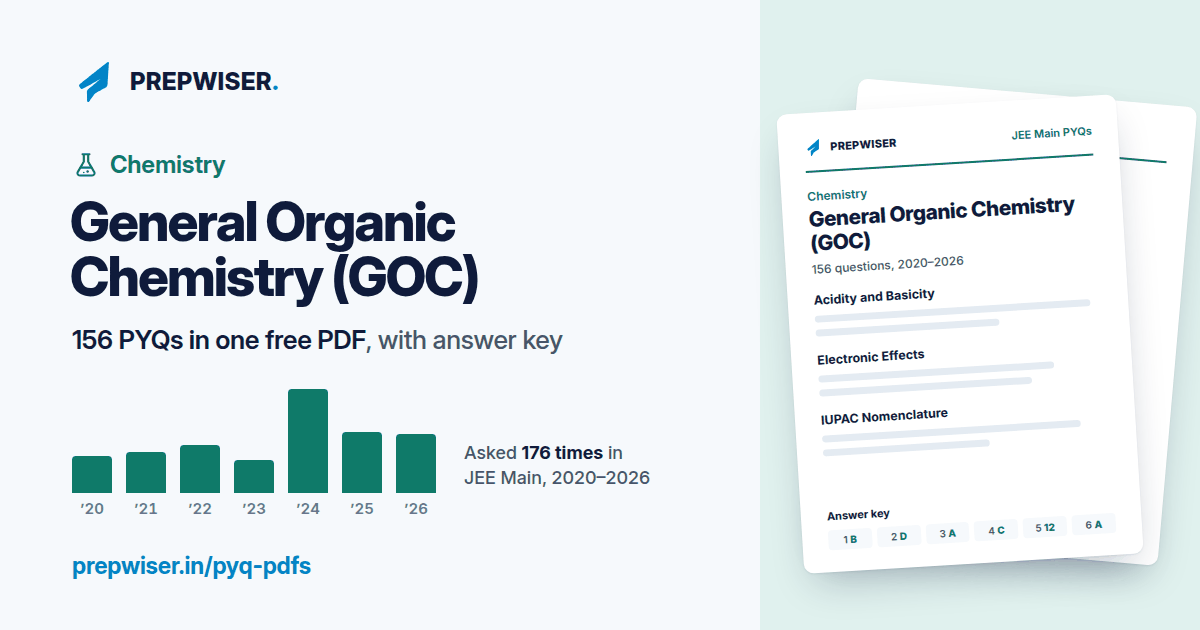
The link opens this page: the free PDF with 156 questions and answers, and online practice. Nobody needs to log in.
| Year | Asked | In PDF | |
|---|---|---|---|
| 2026 | 27 | 26 | |
| 2025 | 28 | 25 | |
| 2024 | 48 | 44 | |
| 2023 | 15 | 10 | |
| 2022 | 22 | 18 | |
| 2021 | 19 | 17 | |
| 2020 | 17 | 16 |
in the free PDF asked, not in the PDFThe PDF only has questions we can print in full with a checked answer, so it holds 156 of the 176 asked.
How many General Organic Chemistry (GOC) questions each topic had in every JEE Main year (all shifts), counting every question asked, including ones not in the PDF. Darker cells mean more questions.
| Topic | Asked | Share | 2026 | 2025 | 2024 | 2023 | 2022 | 2021 | 2020 |
|---|---|---|---|---|---|---|---|---|---|
| IUPAC Nomenclature | 41 | 23% | 3 | 10 | 17 | 1 | 4 | 3 | 3 |
| Stereoisomerism | 34 | 19% | 3 | 3 | 9 | 3 | 7 | 2 | 7 |
| Electronic Effects | 32 | 18% | 9 | 1 | 11 | 2 | 3 | 4 | 2 |
| Acidity and Basicity | 23 | 13% | 2 | 3 | 4 | 4 | 2 | 4 | 4 |
| Reaction Intermediates | 23 | 13% | 5 | 7 | 3 | 2 | 3 | 3 | · |
| Structural Isomerism | 17 | 10% | 4 | 3 | 3 | 2 | 1 | 3 | 1 |
| Types of Organic Reactions | 6 | 4% | 1 | 1 | 1 | 1 | 2 | · | · |
| All topics | 176 | 100% | 27 | 28 | 48 | 15 | 22 | 19 | 17 |
Swipe the table sideways for older years.
The 12 newest of the 26 JEE Main 2026 General Organic Chemistry (GOC) questions in the free PDF, latest shift first. The 2026 papers asked 27 in all.
JEE Main 2026 · 8 Apr · Shift 2 · Reaction Intermediates
JEE Main 2026 · 6 Apr · Shift 1 · Structural Isomerism
Given below are two statements :
Statement I : 2, 6-diethylcyclohexanone and 6-methyl-2-n-propylcyclohexanone are metamers.
Statement II : 2, 2, 6, 6 - tetramethylcyclohexanone exhibits keto-enol tautomerism.
In the light of the above statements, choose the correct answer from the options given below
JEE Main 2026 · 6 Apr · Shift 2 · Electronic Effects
Shown below is the structure of methyl acetate with three different and carbon - oxygen bonds.
The correct order of bond lengths of these bonds is :
JEE Main 2026 · 5 Apr · Shift 2 · IUPAC Nomenclature
Identify the correct IUPAC name of hydrocarbon containing three primary carbon atoms and with molar mass .
JEE Main 2026 · 5 Apr · Shift 2 · Electronic Effects
IUPAC name of the some alkenes are given below.
Find out the correct stability order.
A. 2-Methylbut-2-ene
B. cis-But-2-ene
C. 2,3-Dimethylbut-2-ene
D. Prop-1-ene
Choose the correct answer from the options given below :
JEE Main 2026 · 5 Apr · Shift 1 · Reaction Intermediates
Given below are two statements :
Statement I : On the basis of inductive effect, the order of stability of alkyl carbanions is .
Statement II : Allyl and benzyl carbanions are more stabilised by inductive effect and not by resonance effect.
In the light of the above statements, choose the correct answer from the options given below :
JEE Main 2026 · 4 Apr · Shift 2 · Stereoisomerism

JEE Main 2026 · 4 Apr · Shift 2 · Types of Organic Reactions
| List-I Reaction |
List-I Mechanism |
||
|---|---|---|---|
| A. | Williamson Synthesis | I. | Electrophilic addition |
| B. | Friedel Craft Reaction | II. | Free radical substitution |
| C. | Bromination of vinyl benzene | III. | Nucleophilic substitution |
| D. | Chlorination of toluene in light | IV. | Electrophilic substitution |
Choose the correct answer from the options given below:
JEE Main 2026 · 4 Apr · Shift 1 · Acidity and Basicity
Amongst the following, the total number of compounds soluble in aqueous NaOH at room temperature is :

JEE Main 2026 · 4 Apr · Shift 1 · Electronic Effects
Increasing order of electron withdrawing power of following functional groups is :
a. -CN
b. -COOH
c.
d. -I
JEE Main 2026 · 4 Apr · Shift 2 · Acidity and Basicity

Choose the correct answer from the options given below :
JEE Main 2026 · 4 Apr · Shift 2 · Electronic Effects

Practise the 2026 General Organic Chemistry (GOC) questions online
JEE Main 2026 · 2 Apr · Shift 1 · IUPAC Nomenclature
In IUPAC nomenclature, the correct order of decreasing priority of functional group is :
Answer: (C)
JEE Main 2026 · 28 Jan · Shift 1 · Reaction Intermediates
CORRECT order of stability for the following is
Answer: (C)
JEE Main 2026 · 21 Jan · Shift 2 · Stereoisomerism
Statement I : Compound (X), shown below, dissolves in NaHCO3 solution and has two chiral carbon atoms
Statement II : Compound (Y), shown below, has two carbons with sp3 hybridization, one carbon with sp2 and one carbon with sp hybridization
In the light of the above statements, choose the correct answer from the options given below :
Statement I is true but Statement II is false
Both Statement I and Statement II are true
Both Statement I and Statement II are false
Statement I is false but Statement II is true
Answer: (B)
JEE Main 2026 · 21 Jan · Shift 2 · Structural Isomerism
Match List - I with List - II.
| List - I Pair of Compounds |
List - II Type of Isomers |
|---|---|
| A. 2-Methylpropene and but-1-ene | I. Stereoisomers |
| B. Cis-but-2-ene and trans-but-2-ene | II. Position isomers |
| C. 2-Butanol and diethyl ether | III. Chain isomers |
| D. But-1-ene and but-2-ene | IV. Functional group isomers |
Choose the correct answer from the options given below :
A-III, B-I, C-IV, D-II
A-II, B-I, C-IV, D-III
A-I, B-IV, C-III, D-II
A-III, B-I, C-II, D-IV
Answer: (A)
JEE Main 2025 · 3 Apr · Shift 1 · Acidity and Basicity

Answer: (B)
JEE Main 2024 · 1 Feb · Shift 1 · Types of Organic Reactions
Answer: (B)
The free PDF above has all 156 questions grouped by topic, with an answer key.
Answer General Organic Chemistry (GOC) PYQs in the browser, get each one checked instantly and open the step-by-step solution where there is one.
Practise General Organic Chemistry (GOC) online176 questions from 2020 to 2026, about 25 per year. In 2026 it had 27. The free PDF has 156 of them.
By past papers: IUPAC Nomenclature (23%), Stereoisomerism (19%) and Electronic Effects (18%) of all General Organic Chemistry (GOC) questions.
Yes. The PDF and its answer key are free, and you can practise the questions online with no login, with step-by-step solutions where available.
Prefer to solve online? Practise General Organic Chemistry (GOC) online with step-by-step solutions where available, or work through JEE Main papers shift by shift.
JEE Main PYQs by year: 2026 · 2025 · 2024 · 2023 · 2022 · 2021 · 2020
Answers follow NTA's final answer keys. Typing errors are possible, so check doubtful answers against the official key. Spotted a mistake? prepwiser.in/feedback · Terms: prepwiser.in/terms