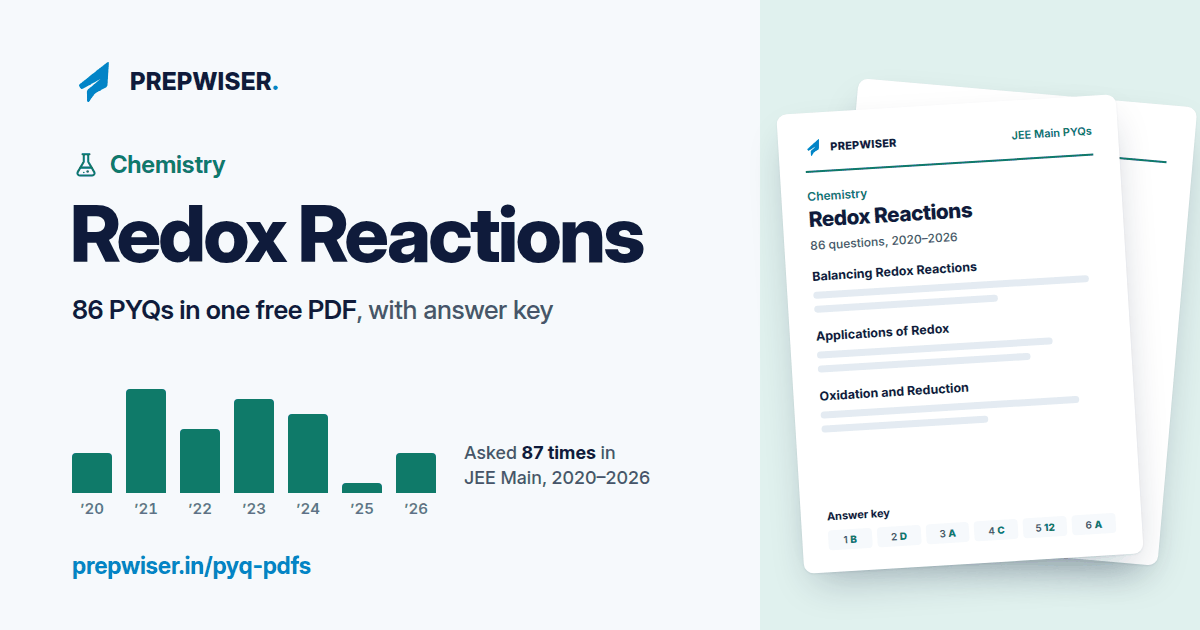
Redox Reactions has 87 questions in JEE Main papers from 2020 to 2026, about 12 per year across all shifts. The free PDF has 86 of them, each with its answer. The most asked topic is Oxidation Number (26 questions), followed by Applications of Redox (20) and Redox in Acidic and Basic Medium (16).
2 of this chapter's questions came back in a later paper (2021–2026). See the most repeated.
How often it's asked in JEE Main
Redox Reactions had about 0.4 questions per shift in recent JEE Main papers (2024–26). Most asked topic in 2024–26: Types of Redox Reactions. About 8 questions in the 2026 papers.
It came up in about 20 of the 2024–26 shifts in our bank. Question types in 2020–2026: about 44 MCQs and about 43 numerical.
How many questions from Redox Reactions in JEE Main, year by year
Year
Questions
Per shift
MCQ
Numerical
2026
8
0.4
4
4
2025
2
0.1
2
0
2024
16
0.8
9
7
2023
19
0.8
8
11
2022
13
0.6
6
7
2021
21
0.8
11
10
2020
8
0.5
4
4
2020–2026
87
0.6
44
43
Most asked Redox Reactions topics, 2020–2026
Topic
Questions
Oxidation Number
26
Applications of Redox
20
Redox in Acidic and Basic Medium
16
Types of Redox Reactions
13
Balancing Redox Reactions
6
Every topic, year by year, is in the topic-wise table further down.
Counted from PrepWiser's question bank of JEE Main papers, 2020–2026. Per shift = questions that year ÷ shifts in our bank. Updated .
in the free PDF asked, not in the PDFThe PDF only has questions we can print in full with a checked answer, so it holds 86 of the 87 asked.
Topic-wise weightage by year
How many Redox Reactions questions each topic had in every JEE Main year (all shifts), counting every question asked, including ones not in the PDF. Darker cells mean more questions.
Topic
Asked
Share
2026
2025
2024
2023
2022
2021
2020
Oxidation Number
26
30%
1
·
4
7
4
7
3
Applications of Redox
20
23%
4
·
1
5
5
4
1
Redox in Acidic and Basic Medium
16
18%
·
·
4
2
2
6
2
Types of Redox Reactions
13
15%
2
2
5
·
2
2
·
Balancing Redox Reactions
6
7%
·
·
1
4
·
1
·
Oxidation and Reduction
6
7%
1
·
1
1
·
1
2
All topics
87
100%
8
2
16
19
13
21
8
Swipe the table sideways for older years.
Newest questions (2026)
All 8 JEE Main 2026 Redox Reactions questions in the free PDF, latest shift first.
JEE Main 2026 · 6 Apr · Shift 2 · Applications of Redox
500 mL of 0.2MMnO4−solution in basic medium when mixed with 500 mL of 1.5 M KI solution, oxidises iodide ions to liberate molecular iodine. This liberated iodine is then titrated with a standard xM thiosulphate solution in presence of starch till the end point. If 300 mL of thiosulphate was consumed, then the value of x is ____。
JEE Main 2026 · 2 Apr · Shift 1 · Types of Redox Reactions
Given below are two statements:
Statement (I): Oxidising power of halogens decreases in the order F2>Cl2>Br2>I2, which is the basis of "Layer test".
Statement (II): "Layer test" to identify Br2 and I2 in aqueous solution involves the oxidation of bromide or iodide into Br2 or I2 respectively with Cl2, which is a type of displacement redox reaction.
In the light of the above statements, choose the correct answer from the options given below:
JEE Main 2026 · 28 Jan · Shift 1 · Applications of Redox
500 mL of 1.2 M KI solution is mixed with 500 mL of 0.2MKMnO4 solution in basic medium. The liberated iodine was titrated with standard 0.1MNa2S2O3 solution in the presence of starch indicator till the blue color disappeared. The volume (in L ) of Na2S2O3 consumed is ____ . (Nearest integer)
JEE Main 2026 · 24 Jan · Shift 1 · Oxidation and Reduction
X and Y are the number of electrons involved, respectively during the oxidation of I−to I2 and S2− to S by acidified K2Cr2O7. The value of X+Y is ____ .
JEE Main 2026 · 24 Jan · Shift 2 · Types of Redox Reactions
One mole of Cl2(g) was passed into 2 L of cold 2 M KOH solution. After the reaction, the concentrations of Cl−,ClO−and OH−are respectively (assume volume remains constant)
JEE Main 2024 · 9 Apr · Shift 1 · Oxidation Number
Given below are two statements :
Statement (I) : The oxidation state of an element in a particular compound is the charge acquired by its atom on the basis of electron gain enthalpy consideration from other atoms in the molecule.
Statement (II) : pπ−pπ bond formation is more prevalent in second period elements over other periods.
In the light of the above statements, choose the most appropriate answer from the options given below :
(A)Statement I is correct but Statement II is incorrect
(B)Both Statement I and Statement II are correct
(C)Statement I is incorrect but Statement II is correct
(D)Both Statement I and Statement II are incorrect
Answers follow NTA's final answer keys. Typing errors are possible, so check doubtful answers against the official key. Spotted a mistake? prepwiser.in/feedback · Terms: prepwiser.in/terms