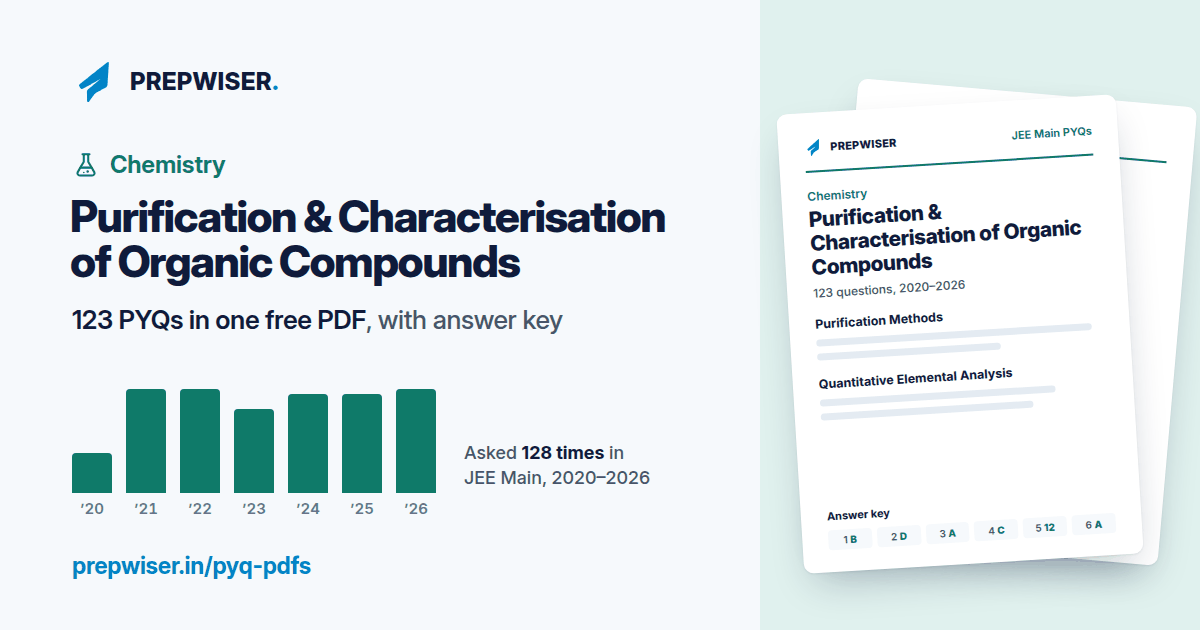
Purification & Characterisation of Organic Compounds JEE Main PYQs PDF, 2020–2026
Purification & Characterisation of Organic Compounds has 128 questions in JEE Main papers from 2020 to 2026, about 18 per year across all shifts. The free PDF has 123 of them, each with its answer. The most asked topic is Quantitative Elemental Analysis (75 questions), followed by Purification Methods (53).
Asked in JEE Main
1282020–2026, all shifts
In this free PDF
123with answers
Asked in 2026
21Latest paper: 2026 Apr S2
Most asked topic
Quantitative Elemental Analysis75 Qs · 59% of the chapter
7 of this chapter's questions came back in a later paper (2021–2026). See the most repeated.
How often it's asked in JEE Main
Purification & Characterisation of Organic Compounds had about 0.6 questions per shift in recent JEE Main papers (2024–26). Most asked topic: Quantitative Elemental Analysis. About 21 questions in the 2026 papers.
It came up in most 2024–26 shifts in our bank (about 51 shifts). Question types in 2020–2026: about 81 MCQs and about 47 numerical.
How many questions from Purification & Characterisation of Organic Compounds in JEE Main, year by year
Year
Questions
Per shift
MCQ
Numerical
2026
21
1.1
13
8
2025
20
1.1
11
9
2024
20
1.0
16
4
2023
17
0.7
11
6
2022
21
0.9
11
10
2021
21
0.8
12
9
2020
8
0.5
7
1
2020–2026
128
0.9
81
47
Most asked Purification & Characterisation of Organic Compounds topics, 2020–2026
Topic
Questions
Quantitative Elemental Analysis
75
Purification Methods
53
Counted from PrepWiser's question bank of JEE Main papers, 2020–2026. Per shift = questions that year ÷ shifts in our bank. Updated .
Purification & Characterisation of Organic Compounds questions per year
Year
Asked
In PDF
2026
21
20
2025
20
20
2024
20
19
2023
17
15
2022
21
21
2021
21
21
2020
8
7
in the free PDF asked, not in the PDFThe PDF only has questions we can print in full with a checked answer, so it holds 123 of the 128 asked.
Topic-wise weightage by year
How many Purification & Characterisation of Organic Compounds questions each topic had in every JEE Main year (all shifts), counting every question asked, including ones not in the PDF. Darker cells mean more questions.
Topic
Asked
Share
2026
2025
2024
2023
2022
2021
2020
Quantitative Elemental Analysis
75
59%
14
14
7
9
12
15
4
Purification Methods
53
41%
7
6
13
8
9
6
4
All topics
128
100%
21
20
20
17
21
21
8
Swipe the table sideways for older years.
Newest questions (2026)
The 12 newest of the 20 JEE Main 2026 Purification & Characterisation of Organic Compounds questions in the free PDF, latest shift first. The 2026 papers asked 21 in all.
Statement I : Vapours of the liquid with higher boiling point condense before vapours of the liquid with lower boiling points in fractional distillation.
Statement II : The vapours rising up in the fractionating column become richer in high boiling component of the mixture.
In the light of the above statements, choose the correct answer from the options given below :
Rf value for 2-methylpropene in a solvent system (Ethyl acetate + ether) is 0.42 . 2-methylpropene is treated with dilute H2SO4 to give major organic product (X). Rf value for (X) in the same solvent system under identical condition will be:
In sulphur estimation, 2.0×10⁻³mol of an organic compound (X) (molar mass 76gmol−1 ) gave 0.4813 g of barium sulphate (molar mass 233gmol−1 ). The percentage of sulphur in the compound (X) is ____×10−1% (Nearest integer)
2.0 g of a bromo hydrocarbon (X) was subjected to Carius analysis, gave 3.36 g of AgBr . The percentage of carbon in the compound (X) is 26.7%. Total number of carbon atoms in the empirical formula for compound (X) is ____ .
(Given molar mass in gmol−1H:1,C:12,Br:80,Ag:108 )
Complete combustion of X g of an organic compound gave 0.25 g of CO2 and 0.12 g of H2O. If the % of carbon is 25% and of hydrogen is 4.89%, then X=×10−3 g. (Nearest integer)
(Molar mass of C, H and O are 12, 1 and 16 g mol−1 respectively.)
When the product (P) is subjected to Carius analysis using AgNO3, 1.0 g of the product (P) will produce _________ g of the precipitate of AgBr. (Nearest Integer)
(Given : molar mass in g mol-1 C : 12, H : 1, O : 16, N : 14, Br : 80, Ag : 108)
JEE Main 2026 · 28 Jan · Shift 1 · Quantitative Elemental Analysis
0.53 g of an organic compound (x) when heated with excess of nitric acid (concentrated) and then with silver nitrate gave 0.75 g of silver bromide precipitate. 1.0 g of (x) gave 1.32 g of CO2 gas on combustion. The percentage of hydrogen in the compound (x) is ____ %. [Nearest Integer]
[Given: Molar mass in gmol−1H:1,C:12,Br:80,Ag:108,O:16; Compound (x) : CxHyBrz]
JEE Main 2026 · 28 Jan · Shift 2 · Quantitative Elemental Analysis
A student has been given 0.314 g of an organic compound and asked to estimate Sulphur. During the experiment, the student has obtained 0.4813 g of barium sulphate. The percentage of sulphur present in the compound is _________. (Given Molar mass in g mol−1 S: 32, BaSO4: 233)
Statement I : Vapours of the liquid with higher boiling point condense before vapours of the liquid with lower boiling points in fractional distillation.
Statement II : The vapours rising up in the fractionating column become richer in high boiling component of the mixture.
In the light of the above statements, choose the correct answer from the options given below :
In sulphur estimation, 2.0×10⁻³mol of an organic compound (X) (molar mass 76gmol−1 ) gave 0.4813 g of barium sulphate (molar mass 233gmol−1 ). The percentage of sulphur in the compound (X) is ____×10−1% (Nearest integer)
The free PDF above has all 123 questions grouped by topic, with an answer key.
Practise these online, free, no login
Answer Purification & Characterisation of Organic Compounds PYQs in the browser, get each one checked instantly and open the step-by-step solution where there is one.
How many questions come from Purification & Characterisation of Organic Compounds in JEE Main?
128 questions from 2020 to 2026, about 18 per year. In 2026 it had 21. The free PDF has 123 of them.
Which Purification & Characterisation of Organic Compounds topics are most important for JEE Main?
By past papers: Quantitative Elemental Analysis (59%) and Purification Methods (41%) of all Purification & Characterisation of Organic Compounds questions.
Is the Purification & Characterisation of Organic Compounds PYQ PDF free?
Yes. The PDF and its answer key are free, and you can practise the questions online with no login, with step-by-step solutions where available.
Answers follow NTA's final answer keys. Typing errors are possible, so check doubtful answers against the official key. Spotted a mistake? prepwiser.in/feedback · Terms: prepwiser.in/terms