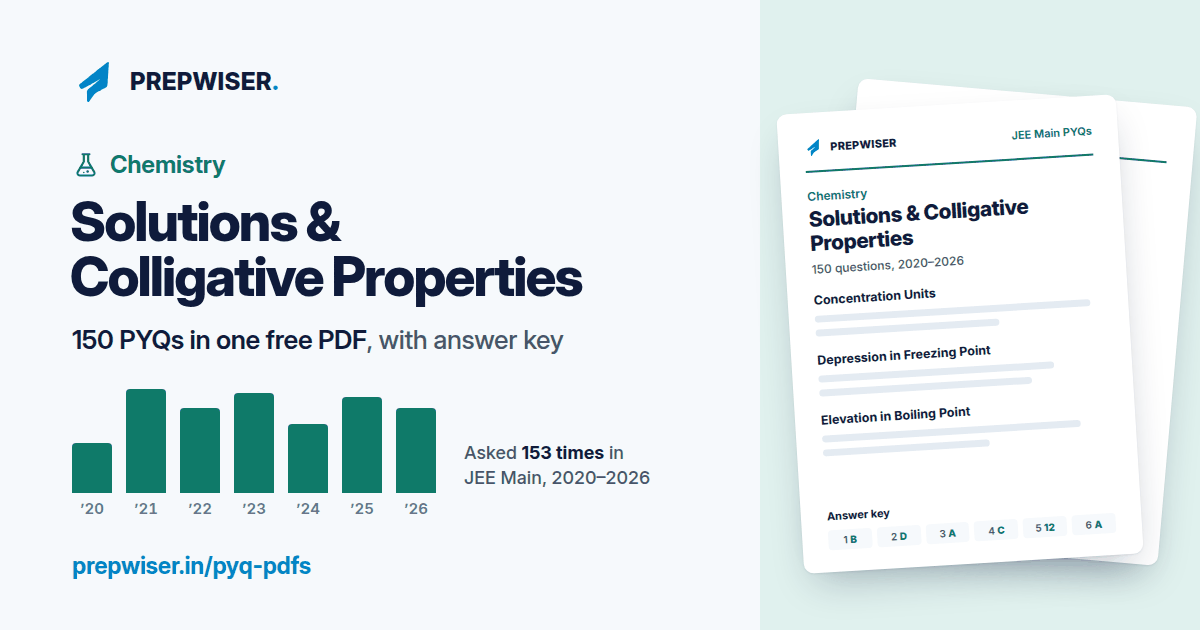
Solutions & Colligative Properties JEE Main PYQs PDF, 2020–2026
Solutions & Colligative Properties has 153 questions in JEE Main papers from 2020 to 2026, about 22 per year across all shifts. The free PDF has 150 of them, each with its answer. The most asked topic is Depression in Freezing Point (36 questions), followed by Raoult's Law (33) and Elevation in Boiling Point (28).
Asked in JEE Main
1532020–2026, all shifts
In this free PDF
150with answers
Asked in 2026
22Latest paper: 2026 Apr S2
Most asked topic
Depression in Freezing Point36 Qs · 23% of the chapter
Difficulty mix
39% easy · 60% medium · 1% hardof the questions in the PDF
8 of this chapter's questions came back in a later paper (2021–2026). See the most repeated.
How often it's asked in JEE Main
Solutions & Colligative Properties had about 1.1 questions per shift in recent JEE Main papers (2024–26). Most asked topic in 2024–26: Raoult's Law. About 22 questions in the 2026 papers.
It came up in most 2024–26 shifts in our bank (about 51 shifts). Question types in 2020–2026: about 62 MCQs and about 91 numerical.
How many questions from Solutions & Colligative Properties in JEE Main, year by year
Year
Questions
Per shift
MCQ
Numerical
2026
22
1.2
17
5
2025
25
1.3
20
5
2024
18
0.9
7
11
2023
26
1.1
4
22
2022
22
1.0
6
16
2021
27
1.0
2
25
2020
13
0.8
6
7
2020–2026
153
1.0
62
91
Most asked Solutions & Colligative Properties topics, 2020–2026
Topic
Questions
Depression in Freezing Point
36
Raoult's Law
33
Elevation in Boiling Point
28
Osmotic Pressure
26
Concentration Units
11
Every topic, year by year, is in the topic-wise table further down.
Counted from PrepWiser's question bank of JEE Main papers, 2020–2026. Per shift = questions that year ÷ shifts in our bank. Updated .
Solutions & Colligative Properties questions per year
Year
Asked
In PDF
2026
22
22
2025
25
24
2024
18
18
2023
26
26
2022
22
22
2021
27
26
2020
13
12
in the free PDF asked, not in the PDFThe PDF only has questions we can print in full with a checked answer, so it holds 150 of the 153 asked.
Topic-wise weightage by year
How many Solutions & Colligative Properties questions each topic had in every JEE Main year (all shifts), counting every question asked, including ones not in the PDF. Darker cells mean more questions.
Topic
Asked
Share
2026
2025
2024
2023
2022
2021
2020
Depression in Freezing Point
36
23%
·
5
6
6
7
10
2
Raoult's Law
33
22%
6
6
3
5
3
4
6
Elevation in Boiling Point
28
18%
5
4
2
4
5
7
1
Osmotic Pressure
26
17%
6
3
4
6
3
1
3
Concentration Units
11
7%
·
3
2
2
1
2
1
Van't Hoff Factor
10
7%
2
3
1
3
·
1
·
Henry's Law
9
6%
3
1
·
·
3
2
·
All topics
153
100%
22
25
18
26
22
27
13
Swipe the table sideways for older years.
Newest questions (2026)
The 12 newest of the 22 JEE Main 2026 Solutions & Colligative Properties questions in the free PDF, latest shift first.
JEE Main 2026 · 8 Apr · Shift 2 · Elevation in Boiling Point
Which of the following statements are not correct?
A. For water, magnitude of Kb is more than the magnitude of Kf.
B. The elevation in boiling point of water when a non-volatile solute is added to it is larger in magnitude than its depression in freezing point.
C. Osmotic pressure measurement is preferred over any other colligative property to determine molar mass of proteins and polymers.
D. The dimerised form of benzoic acid in benzene isC6H5−C∥O−OH⋅⋅⋅⋅O=C∣OH−C6H5
Choose the correct answer from the options given below :
Given : Molar mass of C,H,O,Cl are 12,1,16 and 35.5gmol−1, respectively
Statement I : In 30%(w/w) solution of methanol in CCl4( at T K), the mole fraction of CCl4 is equal to 0.33 .
Statement II : Mixture of methanol and CCl4 shows positive deviation from Raoult's law. In the light of the above statements, choose the correct answer from the options given below :
When 0.25 moles of a non-volatile, non-ionizable solute was dissolved in 1 mole of a solvent the vapor pressure of solution was x% of vapor pressure of pure solvent. What is x% ?
Statement I :H2O molecules move from the chamber 1 to chamber 2 .
Statement II : The osmotic pressure of a solution prepared by dissolving 50 mg of potassium sulphate (molar mass =174g/mol ) in 2 L of water (at 27∘C ) is 0.0107 bar. (Given: R=0.083dm3 bar K−1mol−1 and assume complete dissociation of electrolyte)
In the light of the above statements, choose the correct answer from the options given below :
20 g hemoglobin in a 1 L aqueous solution (A) at 300 K is separated from pure water by semi permeable membrane. At equilibrium the height of solution in a tube dipped in a solution (A) is found to be 80.0 mm higher than the tube dipped in water.
The molar mass of hemoglobin is ____kgmol−1. (Nearest integer)
(Given : g=10ms−2,R=8.3kPadmK−1mol−1, density of solution =1000kgm−3 )
JEE Main 2026 · 4 Apr · Shift 1 · Elevation in Boiling Point
A non-volatile, non-electrolyte solid solute when dissolved in 40 g of a solvent, the vapour pressure of the solvent decreased from 760 mm Hg to 750 mm Hg . If the same solution boils at 320 K , then the number of moles of the solvent present in the solution is ____ . (Nearest integer)
[Given: boiling point of the pure solvent =319.5K,
At 27∘C,0.1M,1LK4[Fe(CN)6] aqueous solution and 0.1M,1LFeCl3 aqueous solution are placed in a container separated by a semi permeable membrane AB . Assume complete dissociation of both the solutes. Which of the following statement is correct?
Solution A is prepared by dissolving 1 g of a protein (molar mass = 50,000 g mol-1) in 0.5 L of water at 300 K. Its osmotic pressure is x bar. Solution B is made by dissolving 2 g of the same protein in 1 L of water at 300 K. Osmotic pressure of solution B is y bar. Entire solution of A is mixed with entire solution of B at the same temperature. The osmotic pressure of resultant solution is z bar. x, y and z respectively are: (R = 0.083 L bar mol-1 K-1)
19.5 g of fluoro acetic acid (molar mass = 78 g mol−1) is dissolved in 500 g of water at 298 K. The depression in the freezing point of water was 1∘C. What is Ka of fluoro acetic acid?
(For water, Kf=1.86 K kg mol−1). Assume molarity and molality to have same values.
At T(K),2 moles of liquid A and 3 moles of liquid B are mixed. The vapour pressure of ideal solution formed is 320 mm Hg . At this stage, one mole of A and one mole of B are added to the solution. The vapour pressure is now measured as 328.6 mm Hg . The vapour pressure (in mm Hg ) of A and B are respectively:
JEE Main 2026 · 24 Jan · Shift 1 · Van't Hoff Factor
' W ' g of a non-volatile electrolyte solid solute of molar mass ' M ' gmol−1 when dissolved in 100 mL water, decreases vapour pressure of water from 640 mm Hg to 600 mm Hg . If aqueous solution of the electrolyte boils at 375 K and Kb for water is 0.52Kkgmol−1, then the mole fraction of the electrolyte solute (x2) in the solution can be expressed as
(Given : density of water =1g/mL and boiling point of water =373K )
At 298 K , the mole percentage of N2(g) in air is 80%. Water is in equilibrium with air at a pressure of 10 atm . What is the mole fraction of N2(g) in water at 298 K ? (KH for N2 is 6.5×10⁷mmHg)
JEE Main 2025 · 4 Apr · Shift 2 · Concentration Units
Sea water, which can be considered as a 6 molar (6M) solution of NaCl , has a density of 2gmL−1. The concentration of dissolved oxygen (O2) in sea water is 5.8 ppm . Then the concentration of dissolved oxygen (O2) in sea water, is x×10−4m.
How many questions come from Solutions & Colligative Properties in JEE Main?
153 questions from 2020 to 2026, about 22 per year. In 2026 it had 22. The free PDF has 150 of them.
Which Solutions & Colligative Properties topics are most important for JEE Main?
By past papers: Depression in Freezing Point (23%), Raoult's Law (22%) and Elevation in Boiling Point (18%) of all Solutions & Colligative Properties questions.
Is the Solutions & Colligative Properties PYQ PDF free?
Yes. The PDF and its answer key are free, and you can practise the questions online with no login, with step-by-step solutions where available.
Answers follow NTA's final answer keys. Typing errors are possible, so check doubtful answers against the official key. Spotted a mistake? prepwiser.in/feedback · Terms: prepwiser.in/terms