JEE Main 2023 · 31 Jan · Shift 1 · Colloids and Emulsions
Adding surfactants in non polar solvent, the micelles structure will look like

- (A)d
- (B)a
- (C)c
- (D)b
Show answerHide answer
Answer: (B)
This chapter was removed from the JEE Main syllabus in 2024. These are older PYQs. See what changed →
Surface Chemistry has 82 questions in JEE Main papers from 2020 to 2023, about 21 per year across all shifts. All 82 are in the free PDF, with an answer key. The most asked topic is Colloids (32 questions), followed by Adsorption (16) and Adsorption Isotherms (13).
Answer key includedNo loginPractise online
Source: official NTA JEE Main papers · Updated
Your PDF is downloading. Practise these questions online, free, no login →
2 of this chapter's questions came back in a later paper (2021–2026). See the most repeated.
Surface Chemistry was removed from the JEE Main syllabus in 2024. It had about 0.9 questions per shift in 2020–22 and none since.
It did not come up in the 2024–26 shifts in our bank. Question types in 2020–2026: about 63 MCQs and about 19 numerical.
| Year | Questions | Per shift | MCQ | Numerical |
|---|---|---|---|---|
| 2026 | 0 | 0 | 0 | 0 |
| 2025 | 0 | 0 | 0 | 0 |
| 2024 | 0 | 0 | 0 | 0 |
| 2023 | 23 | 1.0 | 14 | 9 |
| 2022 | 20 | 0.9 | 16 | 4 |
| 2021 | 24 | 0.9 | 21 | 3 |
| 2020 | 15 | 0.9 | 12 | 3 |
| 2020–2026 | 82 | 0.6 | 63 | 19 |
| Topic | Questions |
|---|---|
| Colloids | 32 |
| Adsorption | 16 |
| Adsorption Isotherms | 13 |
| Coagulation | 10 |
| Catalysis | 7 |
Every topic, year by year, is in the topic-wise table further down.
Counted from PrepWiser's question bank of JEE Main papers, 2020–2026. Per shift = questions that year ÷ shifts in our bank. Updated .
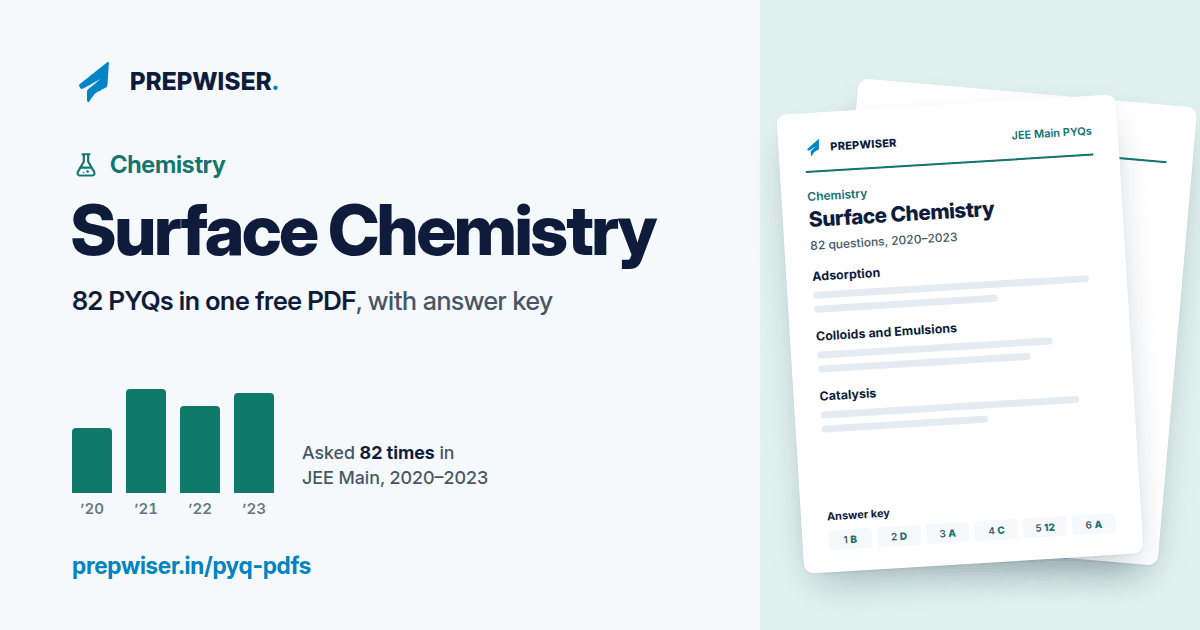
The link opens this page: the free PDF with 82 questions and answers, and online practice. Nobody needs to log in.
| Year | Asked | In PDF | |
|---|---|---|---|
| 2023 | 23 | 23 | |
| 2022 | 20 | 20 | |
| 2021 | 24 | 24 | |
| 2020 | 15 | 15 |
How many Surface Chemistry questions each topic had in every JEE Main year (all shifts), counting every question asked, including ones not in the PDF. Darker cells mean more questions.
| Topic | Asked | Share | 2023 | 2022 | 2021 | 2020 |
|---|---|---|---|---|---|---|
| Colloids | 32 | 39% | 5 | 9 | 11 | 7 |
| Adsorption | 16 | 19% | 9 | 3 | 2 | 2 |
| Adsorption Isotherms | 13 | 16% | 3 | 2 | 5 | 3 |
| Coagulation | 10 | 12% | 4 | 1 | 3 | 2 |
| Catalysis | 7 | 9% | 1 | 3 | 2 | 1 |
| Colloids and Emulsions | 3 | 4% | 1 | 1 | 1 | · |
| Emulsions and Gels | 1 | 1% | · | 1 | · | · |
| All topics | 82 | 100% | 23 | 20 | 24 | 15 |
Swipe the table sideways for older years.
The 12 newest of the 23 JEE Main 2023 Surface Chemistry questions in the free PDF, latest shift first.
JEE Main 2023 · 15 Apr · Shift 1 · Coagulation
JEE Main 2023 · 13 Apr · Shift 1 · Colloids
What happens when a lyophilic sol is added to a lyophobic sol?
JEE Main 2023 · 13 Apr · Shift 2 · Colloids
Given below are two statements, one is labelled as Assertion A and the other is labelled as Reason R.
Assertion A : The diameter of colloidal particles in solution should not be much smaller than wavelength of light to show Tyndall effect.
Reason R : The light scatters in all directions when the size of particles is large enough.
In the light of the above statements, choose the correct answer from the options given below:
JEE Main 2023 · 12 Apr · Shift 1 · Adsorption
Four gases A, B, C and D have critical temperatures and respectively. For their adsorption on a fixed amount of charcoal, the correct order is:
JEE Main 2023 · 11 Apr · Shift 2 · Catalysis
The number of correct statements about modern adsorption theory of heterogeneous catalysis from the following is __________
A. The catalyst is diffused over the surface of reactants.
B. Reactants are adsorbed on the surface of the catalyst.
C. Occurrence of chemical reaction on the catalyst's surface through formation of an intermediate.
D. It is a combination of intermediate compound formation theory and the old adsorption theory.
E. It explains the action of the catalyst as well as those of catalytic promoters and poisons.
JEE Main 2023 · 10 Apr · Shift 2 · Coagulation
Ferric chloride is applied to stop bleeding because -
JEE Main 2023 · 10 Apr · Shift 1 · Adsorption
The enthalpy change for the adsorption process and micelle formation respectively are
JEE Main 2023 · 8 Apr · Shift 2 · Coagulation
Coagulating value of the electrolytes and for are 0.09 and 50.04 respectively. The coagulating power of is times the coagulating power of . The value of is ___________.
JEE Main 2023 · 8 Apr · Shift 1 · Adsorption Isotherms
Which of the following represent the Freundlich adsorption isotherms?


Choose the correct answer from the options given below:
JEE Main 2023 · 6 Apr · Shift 1 · Adsorption
For the adsorption of hydrogen on platinum, the activation energy is and for the adsorption of hydrogen on nickel, the activation energy is . The logarithm of the ratio of the rates of chemisorption on equal areas of the metals at is __________ (Nearest integer)
Given:
JEE Main 2023 · 6 Apr · Shift 2 · Colloids
The number of colloidal systems from the following, which will have 'liquid' as the dispersion medium, is ___________.
Gem stones, paints, smoke, cheese, milk, hair cream, insecticide sprays, froth, soap lather
JEE Main 2023 · 1 Feb · Shift 2 · Adsorption Isotherms
In figure, a straight line is given for Freundrich Adsorption (). The value of and are respectively.

JEE Main 2023 · 31 Jan · Shift 1 · Colloids and Emulsions
Adding surfactants in non polar solvent, the micelles structure will look like
Answer: (B)
JEE Main 2023 · 30 Jan · Shift 2 · Adsorption Isotherms
Answer: 16
JEE Main 2022 · 28 Jul · Shift 1 · Catalysis
Match List - I with List - II.
| List - I Reaction |
List - II Catalyst |
||
|---|---|---|---|
| (A) | (I) | ||
| (B) | (II) | ||
| (C) | (III) | ||
| (D) | (IV) |
Choose the correct answer from the options given below :
Answer: (C)
JEE Main 2022 · 24 Jun · Shift 1 · Emulsions and Gels
Given below are two statements :
Statement I : Emulsions of oil in water are unstable and sometimes they separate into two layers on standing.
Statement II : For stabilisation of an emulsion, excess of electrolyte is added.
In the light of the above statements, choose the most appropriate answer from the options given below :
Answer: (C)
The free PDF above has all 82 questions grouped by topic, with an answer key.
Answer Surface Chemistry PYQs in the browser, get each one checked instantly and open the step-by-step solution where there is one.
Practise Surface Chemistry online82 questions from 2020 to 2023, about 21 per year. In 2023 it had 23.
By past papers: Colloids (39%), Adsorption (19%) and Adsorption Isotherms (16%) of all Surface Chemistry questions.
Yes. The PDF and its answer key are free, and you can practise the questions online with no login, with step-by-step solutions where available.
Prefer to solve online? Practise Surface Chemistry online with step-by-step solutions where available, or work through JEE Main papers shift by shift.
JEE Main PYQs by year: 2026 · 2025 · 2024 · 2023 · 2022 · 2021 · 2020
Answers follow NTA's final answer keys. Typing errors are possible, so check doubtful answers against the official key. Spotted a mistake? prepwiser.in/feedback · Terms: prepwiser.in/terms