PREPWISER.

p-Block Elements: Part I (Group 13 & 14) JEE Main PYQs PDF, 2020–2026

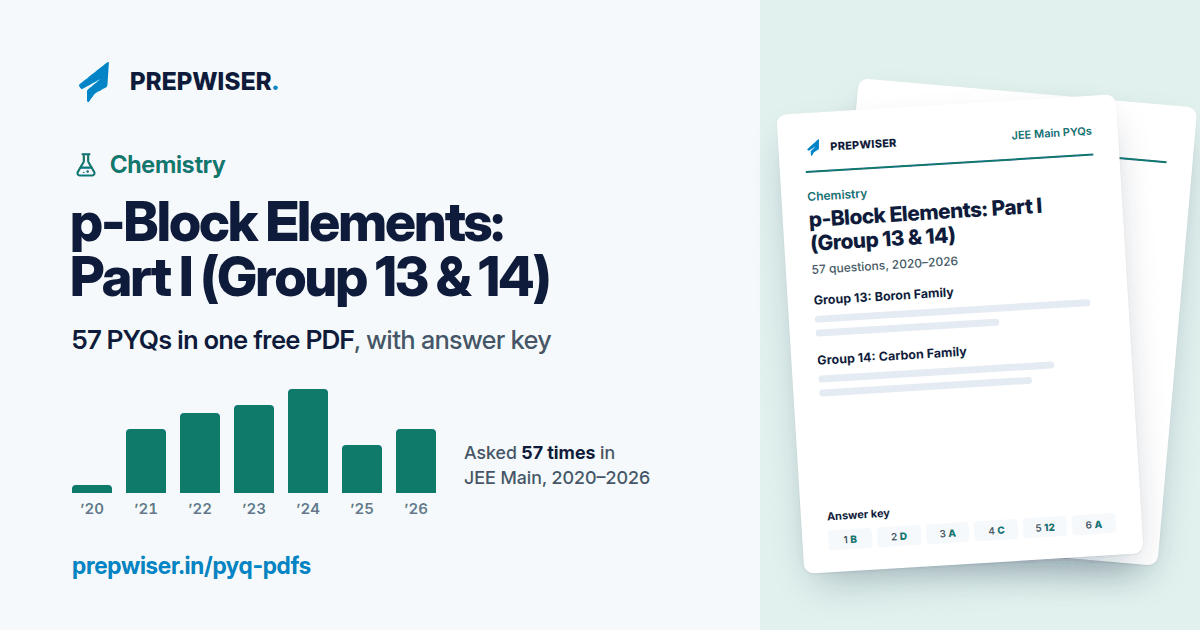
p-Block Elements: Part I (Group 13 & 14) has 57 questions in JEE Main papers from 2020 to 2026, about 8.1 per year across all shifts. All 57 are in the free PDF, with an answer key. The most asked topic is Group 13: Boron Family (40 questions), followed by Group 14: Carbon Family (17).

Asked in JEE Main
572020–2026, all shifts
In this free PDF
57all of them, with answers
Asked in 2026
8Latest paper: 2026 Apr S1
Most asked topic
Group 13: Boron Family40 Qs · 70% of the chapter
Difficulty mix
49% easy · 51% mediumof the questions in the PDF

Answer key includedNo loginPractise online

Source: official NTA JEE Main papers · Updated

Practise these 57 questions free, no login Download PDF (0.2 MB)

How often it's asked in JEE Main

p-Block Elements: Part I (Group 13 & 14) had about 0.5 questions per shift in recent JEE Main papers (2024–26). Most asked topic: Group 13: Boron Family. About 8 questions in the 2026 papers. (Some topics were cut in 2024; see what changed.)

It came up in about 25 of the 2024–26 shifts in our bank. Question types in 2020–2026: about 55 MCQs and about 2 numerical.

How many questions from p-Block Elements: Part I (Group 13 & 14) in JEE Main, year by year

YearQuestionsPer shiftMCQNumerical
202680.480
202560.360
2024130.7121
2023110.5101
2022100.4100
202180.380
202010.110
2020–2026570.4552

Most asked p-Block Elements: Part I (Group 13 & 14) topics, 2020–2026

TopicQuestions
Group 13: Boron Family40
Group 14: Carbon Family17

Counted from PrepWiser's question bank of JEE Main papers, 2020–2026. Per shift = questions that year ÷ shifts in our bank. Updated .

Download these numbers (CSV)

See all chapters' weightage →

Revise p-Block Elements: Part I (Group 13 & 14) before you practise

Two free sheets, made from the past JEE Main questions on this chapter.

Share card for p-Block Elements: Part I (Group 13 & 14): JEE Main PYQs with answers, free PDF

Send this chapter to your study group

The link opens this page: the free PDF with 57 questions and answers, and online practice. Nobody needs to log in.

p-Block Elements: Part I (Group 13 & 14) questions per year

YearAskedIn PDF
202688
202566
20241313
20231111
20221010
202188
202011

Topic-wise weightage by year

How many p-Block Elements: Part I (Group 13 & 14) questions each topic had in every JEE Main year (all shifts), counting every question asked, including ones not in the PDF. Darker cells mean more questions.

TopicAskedShare2026202520242023202220212020
Group 13: Boron Family4070%5498851
Group 14: Carbon Family1730%324323·
All topics57100%8613111081

Swipe the table sideways for older years.

Newest questions (2026)

All 8 JEE Main 2026 p-Block Elements: Part I (Group 13 & 14) questions in the free PDF, latest shift first.

  1. JEE Main 2026 · 6 Apr · Shift 1 · Group 13: Boron Family

    Given below are two statements :

    Statement I : Aluminium is more electropositive than thallium as the standard electrode potential value of E∘Al3+/Al{\mathrm{E}}^{{\circ}}{\mathrm{Al}}^{{3+}}/{\mathrm{Al}} is negative and E∘Tl3+/Tl{\mathrm{E}}^{{\circ}}{\mathrm{Tl}}^{{3+}}/{\mathrm{Tl}} is positive.

    Statement II : The sum of first three ionization enthalpies of boron is very high when compared to that of aluminium. Due to this reason boron forms covalent compounds only and aluminium forms Al3+{\mathrm{Al}}^{{3+}} ion.

    In the light of the above statements, choose the correct answer from the options given below

    Solve it online →
  2. JEE Main 2026 · 4 Apr · Shift 2 · Group 13: Boron Family

    The electronegativity of a group 13 element ' E ' is same as that of Ge (on Pauling scale and upto one decimal point). The CORRECT statements about E3+{\mathrm{E}}^{{3+}} are

    A. It can act as a reducing agent.

    B. It can act as an oxidizing agent.

    C. E3+{\mathrm{E}}^{{3+}} is more stable than E+{\mathrm{E}}^{{+}}.

    D. The standard electrode potential value for E3+/E{\mathrm{E}}^{{3+}}/{\mathrm{E}} is positive.

    Choose the correct answer from the options given below :

    Solve it online →
  3. JEE Main 2026 · 2 Apr · Shift 2 · Group 13: Boron Family

    Given below are two statements :

    Statement I: The second ionization enthalpy of B, Al and Ga is in the order of B > Al > Ga.

    Statement II: The correct order in terms of first ionization enthalpy is Si < Ge < Pb < Sn.

    In the light of the above statements, choose the correct answer from the options given below :

    Solve it online →
  4. JEE Main 2026 · 28 Jan · Shift 2 · Group 13: Boron Family

    Consider the following reactions

    Na2B4O7→Δ  2X+Y{\mathrm{Na}_{2}\mathrm{B}_{4}\mathrm{O}_{7}}{{}\xrightarrow{\Delta\;}}2X+Y

    CuSO4+Y→Non-Luminous flame  Z+SO3{\mathrm{CuSO}_{4}}+Y{{}\xrightarrow{\text{Non-Luminous flame}\;}}Z+SO_{3}

    2Z+2X+Carbon→Luminous flame  2Q+Na2B4O7+CO2Z+2X+\text{Carbon}{{}\xrightarrow{\text{Luminous flame}\;}}2Q+{\mathrm{Na}_{2}\mathrm{B}_{4}\mathrm{O}_{7}}+CO

    The oxidation states of Cu in Z and Q, respectively are :

    Solve it online →
  5. JEE Main 2026 · 24 Jan · Shift 2 · Group 14: Carbon Family

    Choose the INCORRECT statement

    Solve it online →
  6. JEE Main 2026 · 23 Jan · Shift 1 · Group 13: Boron Family

    The correct statements from the following are :

    A. Ionic radii of trivalent cations of group 13 elements decreases down the group.

    B. Electronegativity of group 13 elements decreases down the group.

    C. Among the group 13 elements, Boron has highest first ionisation enthalpy.

    D. The trichloride and triiodide of group 13 elements are covalent in nature.

    Choose the correct answer from the options given below :

    Solve it online →
  7. JEE Main 2026 · 23 Jan · Shift 2 · Group 14: Carbon Family

    It is noticed that Pb2+{\mathrm{Pb}}^{{2+}} is more stable than Pb4+{\mathrm{Pb}}^{{4+}} but Sn2+{\mathrm{Sn}}^{{2+}} is less stable than Sn4+{\mathrm{Sn}}^{{4+}}. Observe the following reactions.

    PbO2+Pb→2PbO;ΔrG∘(1)SnO2+Sn→2SnO;ΔrG∘(2)\begin{array}{cc} & {\mathrm{PbO}}_{2}+{\mathrm{Pb}}\rightarrow 2{\mathrm{PbO}};\Delta_{{{\mathrm{r}}}}{\mathrm{G}}^{{\circ}}(1) \\ & {\mathrm{SnO}}_{2}+{\mathrm{Sn}}\rightarrow 2{\mathrm{SnO}};\Delta_{{{\mathrm{r}}}}{\mathrm{G}}^{{\circ}}(2)\end{array}

    Identify the correct set from the following

    Solve it online →
  8. JEE Main 2026 · 21 Jan · Shift 1 · Group 14: Carbon Family

    Given below are two statements :

    Statement I : The number of pairs among [SiO2,CO2],[SnO,SnO2],[PbO,PbO2][{\mathrm{SiO}}_{2},{\mathrm{CO}}_{2}],[{\mathrm{SnO}},{\mathrm{SnO}}_{2}],[{\mathrm{PbO}},{\mathrm{PbO}}_{2}] and [GeO,GeO2][{\mathrm{GeO}},{\mathrm{GeO}}_{2}], which contain oxides that are both amphoteric is 2 .

    Statement II : BF3{\mathrm{BF}}_{3} is an electron deficient molecule, can act as a Lewis acid, forms adduct with NH3{\mathrm{NH}}_{3} and has a trigonal planar geometry.

    In the light of the above statements, choose the correct answer from the options given below :

    Solve it online →

Practise the 2026 p-Block Elements: Part I (Group 13 & 14) questions online

Sample questions from recent papers

JEE Main 2026 · 6 Apr · Shift 1 · Group 13: Boron Family

Given below are two statements :

Statement I : Aluminium is more electropositive than thallium as the standard electrode potential value of E∘Al3+/Al{\mathrm{E}}^{{\circ}}{\mathrm{Al}}^{{3+}}/{\mathrm{Al}} is negative and E∘Tl3+/Tl{\mathrm{E}}^{{\circ}}{\mathrm{Tl}}^{{3+}}/{\mathrm{Tl}} is positive.

Statement II : The sum of first three ionization enthalpies of boron is very high when compared to that of aluminium. Due to this reason boron forms covalent compounds only and aluminium forms Al3+{\mathrm{Al}}^{{3+}} ion.

In the light of the above statements, choose the correct answer from the options given below

  1. (A)

    Both Statement I and Statement II are true

  2. (B)

    Both Statement I and Statement II are false

  3. (C)

    Statement I is true but Statement II is false

  4. (D)

    Statement I is false but Statement II is true

Show answerHide answer

Answer: (A)

Solve online

JEE Main 2026 · 24 Jan · Shift 2 · Group 14: Carbon Family

Choose the INCORRECT statement

  1. (A)

    Carbon exhibits negative oxidation states along with +4 and +2 .

  2. (B)

    Carbon cannot exceed its covalency more than four.

  3. (C)

    Among the isotopes of carbon, 13C{}^{{13}}{\mathrm{C}} is a radioactive isotope.

  4. (D)

    CO2{\mathrm{CO}}_{2} is the most acidic oxide among the dioxides of group of 14 elements.

Show answerHide answer

Answer: (C)

Solve online

The free PDF above has all 57 questions grouped by topic, with an answer key.

Practise these online, free, no login

Answer p-Block Elements: Part I (Group 13 & 14) PYQs in the browser, get each one checked instantly and open the step-by-step solution where there is one.

Practise p-Block Elements: Part I (Group 13 & 14) online

Frequently asked

How many questions come from p-Block Elements: Part I (Group 13 & 14) in JEE Main?

57 questions from 2020 to 2026, about 8.1 per year. In 2026 it had 8.

Which p-Block Elements: Part I (Group 13 & 14) topics are most important for JEE Main?

By past papers: Group 13: Boron Family (70%) and Group 14: Carbon Family (30%) of all p-Block Elements: Part I (Group 13 & 14) questions.

Is the p-Block Elements: Part I (Group 13 & 14) PYQ PDF free?

Yes. The PDF and its answer key are free, and you can practise the questions online with no login, with step-by-step solutions where available.

More Chemistry chapters

JEE Main PYQs by year: 2026 · 2025 · 2024 · 2023 · 2022 · 2021 · 2020

Answers follow NTA's final answer keys. Typing errors are possible, so check doubtful answers against the official key. Spotted a mistake? prepwiser.in/feedback · Terms: prepwiser.in/terms